
# Activated carbon filter used for months, TDS unchanged—was it a waste of money?
Many households install an activated carbon filter, test with a portable water quality tester, and find the TDS value is about the same as tap water—then suspect the filter isn't working. This judgment confuses two different concepts: TDS measures dissolved ions, while activated carbon mainly removes chlorine, some organic matter, and odors. Unchanged TDS does not mean the activated carbon isn't working.
Why activated carbon has "no effect" on TDS
Activated carbon removes residual chlorine, some disinfection by-products, volatile organic compounds, and substances affecting taste and odor through physical adsorption. Most of these targets do not exist as dissolved ions and do not directly contribute to the TDS reading. TDS reflects dissolved salts such as calcium, magnesium, sodium, and potassium, plus some inorganic substances; activated carbon basically does not adsorb these inorganic ions. Therefore, as long as the dissolved salt concentration in the water does not change, the TDS reading stays stable even if the activated carbon is effectively adsorbing chlorine and organics.
For example: after tap water passes through a new activated carbon filter, TDS may stay around 150 mg/L from start to finish; but if tested with a rapid residual chlorine reagent, the inlet water may have noticeable residual chlorine while the outlet water shows almost none. This precisely shows the activated carbon is normally performing its residual chlorine adsorption capacity—only the TDS indicator cannot reflect it.
To judge whether activated carbon is effective, look at the corresponding indicators and certifications
To confirm whether an activated carbon filter is effective against specific contaminants, look at certifications and corresponding tests. The U.S. CDC recommends that when choosing a home water filter, you should choose a product that is third-party certified and addresses actual local water quality issues, and confirm the certification covers the target contaminants [1]. NSF also explains that certification only indicates the product has reduction capability for the listed contaminants under specific test conditions, and does not mean it is effective against all contaminants [2].
For example, if you care about residual chlorine and odors, choose a filter certified to NSF/ANSI 42; if you care about lead, VOCs, etc., check whether it meets the corresponding NSF/ANSI 53 clauses. This certification information is usually marked on product packaging or the certification body's lookup page. Without corresponding certification or test reports, you cannot judge the filter ineffective just because TDS is unchanged, nor can you assume all contaminants are removed just because TDS drops.
Portable water quality tester: suitable for trend comparison, not compliance testing
A portable water quality tester (such as Water Detective 4) is a field screening tool, suitable for individuals comparing trends of the same water source before and after filter use; it cannot replace laboratory testing required by regulations. The device integrates nine organic and inorganic indicators: TOC, COD, UV254, TDS, EC, turbidity, hardness, salinity, and temperature.
| Parameter | Significance for activated carbon filter evaluation | Limitation |
|---|---|---|
| TDS / EC | Activated carbon basically does not change it; used to confirm inorganic salts are not intercepted or released | Cannot reflect chlorine and most organic matter removal |
| TOC / COD / UV254 | Can indicate overall organic matter level; may decrease when activated carbon removes some organics | Trend reference only; cannot locate specific contaminants |
| Turbidity | Mainly reflects particulate interception, with little relation to activated carbon adsorption | Cannot alone prove activated carbon effectiveness |
| Hardness / Salinity | Estimated from conductivity, limited by water matrix and calibration | Not a precise analytical result |
| Temperature | Affects other parameters; temperature compensation must be noted during measurement | Recorded only as an auxiliary condition |
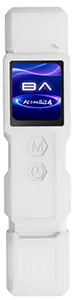
From the table above, if you want to observe the effect of activated carbon on organics, you can compare TOC or UV254 changes before installation, after installation, and after a period of use. However, portable devices have no residual chlorine sensor and cannot directly measure whether residual chlorine is removed; to know residual chlorine removal, you still need rapid residual chlorine test methods such as DPD, or check certification reports.
Steps for home evaluation of activated carbon filter status
- Record raw water baseline: Before installing a new filter, use the same water quality tester to measure and record TDS, EC, and TOC/UV254 (if supported) of the tap water.
- Measure initial value after flushing: Flush according to the instructions until outlet water is stable, then measure once as an initial reference.
- Retest periodically: Retest after 1–3 months of use, keeping sampling method and water temperature consistent. Focus on whether TOC/UV254 changes noticeably from the initial value and whether TDS remains stable.
- Combine with rapid residual chlorine test: If possible, use DPD residual chlorine reagent to compare raw water and filtered water. If residual chlorine drops from noticeable to very low or undetectable, the activated carbon still has residual chlorine adsorption capacity.
- Comprehensive replacement judgment: When TOC/UV254 rises back close to raw water, or residual chlorine removal weakens noticeably, or odors appear in outlet water, decide whether to replace based on the filter's rated life and actual water usage.
Note: Different water sources and filter designs vary greatly; the above steps are only for home trend judgment and cannot serve as safety or compliance proof.
Common misconceptions and applicable limits
- TDS drop means the filter is effective: Not necessarily. Membrane filtration such as reverse osmosis noticeably lowers TDS, but activated carbon does not.
- Unchanged TDS means the filter is ineffective: Wrong. Activated carbon's target is not dissolved salts.
- A portable water quality tester can replace laboratory testing: No. It is for field screening and trend comparison; whether specific contaminants are below standards requires laboratory testing by standard methods.
- Certification means all contaminants are removed: No. NSF certification only covers the listed contaminants and test conditions [2].
Brief FAQ
Q: The activated carbon filter has been used for months and TDS is unchanged—can I keep using it? A: You cannot judge by TDS alone. Consider residual chlorine removal, TOC/UV254 trends (if available), filter life, and water usage. If TDS is stable and residual chlorine is still effectively removed, the activated carbon may still be working normally; if residual chlorine breaks through or taste worsens, consider replacement even if TDS is unchanged.
References
[1] CDC. About Choosing Home Water Filters. https://www.cdc.gov/drinking-water/prevention/about-choosing-home-water-filters.html (accessed 2026-10-29) [2] NSF. Water Filters FAQs. https://www.nsf.org/about-nsf/faqs/water-filters-faqs (accessed 2026-10-29)
Discuss your application
Tell us your target parameters, water matrix, interface and annual volume. Our engineering team will recommend a practical configuration.
Request a Quote