
Direct answer
When topping off evaporated water in an aquarium, TDS (or conductivity, EC) trends are worth recording, but they cannot alone determine whether you should top off, change water, or add minerals—and they cannot be used to infer whether specific ions such as calcium, magnesium, sodium, or chloride are out of balance. Using a portable water quality tester (such as Water Detective 4) to record trends gives you only a "total-quantity clue": evaporation removes pure water and leaves dissolved solids in the tank, so readings rise temporarily before top-off; after topping off with pure water, they should fall back. If readings keep climbing week after week, that points to an additional net input of dissolved solids, not to evaporation itself causing a long-term rise.
Start with the mass balance: evaporation removes only water
Evaporation is like a distillation process that uses no power: water molecules leave the surface, while most salts and minerals stay in the water [1]. So in the short period before top-off, total mass is unchanged while volume decreases, and TDS rises relative to baseline. The temporary concentration before top-off can be estimated with the following simple relationship:
C_evap ≈ C0 × V0 / (V0 − V_evap)
Here C0 is the reading after the last top-off reached equilibrium, V0 is the total water volume in the tank, and V_evap is the amount of water evaporated over that period. As long as there is no precipitation and no additional dosing, topping off with an equal amount of pure water restores the volume and the reading should return to near C0.
What matters is not "how high the TDS reads before top-off" but "whether it returns to the original baseline after topping off with pure water." If it does not return, the tank has a net input.
The same water quality tester pen: two different conclusions before and after top-off
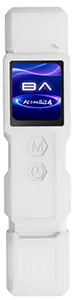
A portable water quality tester pen (such as Water Detective 4) provides readings such as TDS, EC, hardness, and temperature, making it suitable for aquarium water screening and before/after comparisons, but it measures total quantities or related surrogate parameters, not specific ion concentrations. Hardness and salinity are estimated values affected by water matrix and calibration status; use them only for trend comparison, not as a basis for stocking, treatment, or breeding.
The table below helps you avoid mistaking "temporary concentration" for "water quality deterioration."
| Top-off scenario | TDS reading before top-off | Expected after topping off with pure water | Interpretation |
|---|---|---|---|
| Evaporation only, no feeding, no hardware release | Higher than baseline | Returns to near baseline | Only temporary concentration; net dissolved solids did not increase |
| Evaporation + daily feeding/fish metabolism | Rises | May still be above an earlier baseline | Feed and metabolism add extra dissolved solids |
| Topping off evaporated water with tap water | Rises | Depends on tap water TDS/hardness | Tap water brings in new dissolved solids; include tap water readings in the trend |
Note: "returning to baseline" in the table assumes ideal conditions. Filter media, substrate, driftwood, and feed in the tank all continuously release or alter dissolved solids, so small drift is common. The key is recording, not a single reading.
When does a TDS trend actually have reference value?
The value of portable testing lies not in a single-point judgment but in continuous records taken the same way. It is recommended to keep consistent:
- Sampling location: middle of the tank or near the outlet, the same each time;
- Sampling time: before top-off, 30 minutes after top-off, and before/after weekly water changes;
- Recorded parameters: TDS, EC, water temperature, and hardness and salinity if needed [2];
- Record tap water: if you top off with tap water, measure the tap water at the same time to distinguish "net change in the tank" from "change in the water source."
If two or three consecutive records show TDS still climbing week by week after topping off with pure water, this may indicate:
- The water-change ratio or frequency is insufficient to remove accumulated dissolved solids;
- The tap water itself has high hardness/salinity, bringing in more ions over time as evaporation top-off;
- Calcium carbonate sand, coral bone, and similar materials in the tank slowly release calcium and magnesium;
- Bioload or feeding amount has increased.
But a rise in TDS does not mean it is "necessarily harmful," nor does it show which specific ion is involved. Calcium and magnesium in hardness, sodium and chloride in salinity, and nitrate can all contribute to the reading, but their mechanisms of impact differ greatly. To judge whether fish are suited to the water, species-specific GH/KH and ammonia/nitrite/nitrate reagents or laboratory analysis are needed. A portable water quality tester pen does not replace regulatory laboratory testing.
Actionable checklist: topping off evaporated water in a freshwater tank
- Measure TDS/EC once before top-off and record the reading and time.
- Prefer RO/distilled water for topping off evaporated water; if using tap water, measure and record the tap water at the same time.
- Measure again 30 minutes after top-off to see whether it returns to baseline.
- Follow your existing weekly water-change plan, measuring once before and after each change to compare net change.
- If the trend keeps rising, do not adjust water chemistry based on TDS alone; pair it with GH/KH and nitrogen-cycle testing, and consult an aquatic veterinarian or laboratory if needed.
FAQ
Does a rise in TDS mean the aquarium water is "dirty"?
Not necessarily. TDS mainly indicates total dissolved solids, which may come from the hardness of the tap water itself or from feed decomposition. Judge it together with indicators such as ammonia, nitrite, nitrate, and pH.
After topping off evaporated water with pure water, should TDS return to its original value?
Under ideal conditions it will fall back to the previous baseline; if it remains above baseline, there is an additional ion input, such as feeding, fish metabolism, filter media release, or tap water composition.
Can a portable water quality tester pen replace laboratory testing?
No. Water Detective 4 is intended for portable screening and trend comparison of tap water, purified water, travel water, and aquarium water; it is suitable for quick household checks but does not replace laboratory testing required by regulations. When results are abnormal, dedicated reagents or laboratory submission are needed.
References
[1] USGS Water Science School. Conductivity (Electrical Conductance) and Water. https://www.usgs.gov/water-science-school/science/conductivity-electrical-conductance-and-water (accessed 2026-04-30)
[2] Maryland Geological Survey. Hardness. https://mgs.md.gov/groundwater/hardness.html (accessed 2026-04-30)
Discuss your application
Tell us your target parameters, water matrix, interface and annual volume. Our engineering team will recommend a practical configuration.
Request a Quote