
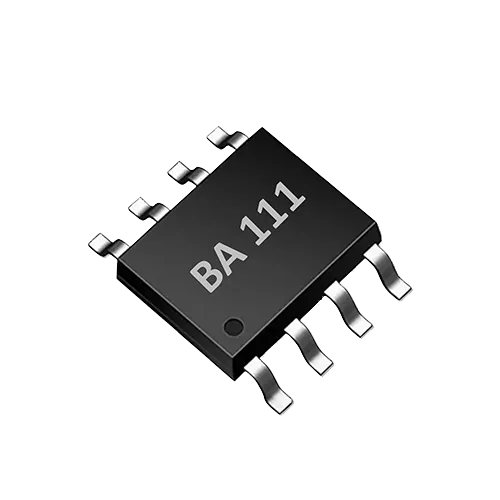
In the electronic control system of water purification equipment, the TDS sensor IC handles signal conditioning and digitization between the conductivity electrode and the MCU. The BA111 is an interface ASIC introduced by Oromë for single-channel TDS and water temperature measurement. Its bipolar probe drive and UART control compress conventional discrete circuits into a very small BOM. This article is for OEM engineers working on water purification equipment. It explains application boundaries, selection criteria and verification methods to clarify which products it suits and which scenarios it does not.
Why Do Water Purifiers Need a TDS Sensor IC?
A TDS sensor works in a simple way: two electrodes touch the water sample and measure the conductivity by applying AC or bipolar excitation. The result is converted into total dissolved solids through temperature correction. The problem is that DC excitation polarizes the electrodes, causing reading drift. Building the measurement chain with discrete op amps, analog switches and ADCs uses many components, produces inconsistent performance and consumes MCU resources.
The BA111 integrates single-channel conductivity measurement, bipolar probe drive, temperature measurement and a UART digital interface into one ASIC. Only a few passive components and an electrode are needed externally. Strictly speaking, it is a single-channel interface IC for conductivity measurement and can be categorized as an EC measurement IC; the TDS value is derived from the conductivity measurement and temperature correction.
Positioning of the BA111 TDS Sensor IC
According to the product documentation, the key boundaries of the BA111 are as follows:
- 0–3000 ppm TDS measurement range
- Single-channel measurement
- Bipolar probe drive reduces electrode polarization
- Integrated TDS temperature correction
- UART control and data output
- Minimal external circuitry
These features make it especially suitable for compact water purification devices with 'one conductivity electrode + one MCU,' rather than systems requiring multiple water quality parameters or multi-probe arrays.
| Key Features | Value for Water Purifier Design |
|---|---|
| 0–3000 ppm TDS measurement | Covers the screening range for common drinking water, purified water output and filtered water |
| Bipolar probe drive | Reduces polarization and improves long-term reading stability |
| Integrated temperature correction | Eliminates external temperature compensation circuitry, simplifying the BOM |
| UART control | Direct connection to the MCU, easing firmware integration |
| Single channel + minimal external circuitry | Suited to small devices, filter life reminders and connected small appliances |
Which Water Purifiers Is It Suitable For?
1. Water dispensers and countertop water purifiers
Water dispensers with water quality displays or filter status indicators usually need only one TDS measurement point. The BA111's single-channel design is adequate for measuring TDS in the tank or at the outlet, while also reading water temperature for the user interface display. The UART output lets the main MCU acquire the data directly without an extra analog front end or high-speed ADC.
2. Household water purifiers and filter life assessment
In RO or ultrafiltration purifiers, TDS is often used to compare incoming and outgoing water to determine if the membrane is compromised or the filter is due for replacement. The BA111 can serve as a single-channel monitoring node for the incoming or outgoing side. One conductivity electrode provides trend data. Note that TDS is only a surrogate indicator and cannot by itself prove compliance or microbiological safety.
3. Smart appliances and pet water dispensers
Smart appliances emphasize miniaturization, low power and easy connectivity. The BA111's minimal external circuitry and UART interface suit integration into pet water fountains, smart kettles and other connected water devices for low-water or filter replacement reminders or water quality status uploads.
4. Unsuited scenarios
- Industrial or high-salinity wastewater: TDS may exceed 3000 ppm, beyond the range specified in the product documentation.
- Multi-channel parallel measurement: The BA111 is single-channel. Multiple probes require multiple chips or a multi-channel solution.
- Laboratory or statutory testing: A complete system without metrological certification cannot replace laboratory analysis; it is limited to on-site screening and trend monitoring.
Selection and Implementation Steps
Engineers evaluating the BA111 can start by answering a few questions:
- Is the expected TDS range of the water sample within 0–3000 ppm?
- Is only one conductivity measurement point needed?
- Does the main controller have UART and can it accept a digital sensor output?
- Is simultaneous water temperature measurement required?
- Is TDS trend determination acceptable instead of statutory testing?
If all answers are 'yes,' the BA111 is a reasonably good match. The following steps are recommended for implementation:
- Choose a conductivity electrode that matches the water quality range, and confirm the cell constant and lead configuration.
- Keep probe leads as short as possible and away from interference sources such as switching power supplies and relays.
- Configure the UART parameters according to the product documentation, read TDS and temperature data, and perform data validation.
- Run temperature-step tests in the end product to verify that the internal temperature correction satisfies display accuracy requirements.
- Compare against known-conductivity standard solutions or a calibrated reference instrument.
Verification Methods and Boundaries
The BA111 provides field-level TDS detection capability for rapid screening and trend monitoring. It is not a metrologically certified analytical instrument. During verification, be explicit about the distinction:
- On-site screening: for filter status, outlet TDS display or connected alarms inside the device.
- Laboratory analysis: for regulatory compliance, type testing or third-party test reports.
Recommended verification methods include:
- Use standard conductivity solutions or TDS calibration solutions to check reading linearity and repeatability.
- Compare against a calibrated portable conductivity meter using the same water samples; field-level deviation is acceptable.
- Run continuously for 24–48 hours and observe stability under bipolar drive, plus any noticeable scaling or polarization on the electrode surface.
- Record TDS output at different water temperatures and confirm that the temperature-corrected variation is within acceptable limits.
FAQ
Is the BA111 a complete TDS sensor IC?
The BA111 is a single-channel interface ASIC for TDS and water temperature measurement. It includes drive, measurement and UART control internally, but requires an external conductivity electrode and a few passive components to form a complete measurement chain. It is not a plug-and-play sensor probe.
What is the relationship between TDS and EC?
TDS is usually derived from conductivity (EC) using a conversion factor that can vary with the water sample. The BA111 is a conductivity measurement interface IC that produces TDS output via internal temperature correction. The specific conversion relationship should be referenced to the product documentation or calibrated with standard solutions.
Can the BA111 be used for drinking water compliance testing?
No. The BA111 is intended for on-site screening and trend monitoring inside the device. It cannot replace laboratory or statutory testing. If the product must issue a compliance report, use certified testing methods and laboratories.
What is the benefit of bipolar drive?
Bipolar drive alternates the polarity across the electrodes, avoiding polarization and electrochemical corrosion caused by unidirectional DC excitation. This improves long-term measurement stability and extends electrode life.
Does the BA111 support multi-channel measurement?
Based on the existing product documentation, the BA111 is single-channel. To monitor multiple points simultaneously, you can use multiple BA111 chips or choose a multi-channel TDS measurement solution, but you will need to evaluate the cost and communication complexity yourself.
Discuss your application
Tell us your target parameters, water matrix, interface and annual volume. Our engineering team will recommend a practical configuration.
Request a Quote