
Should You Replace the Filter? Don't Rely on One Number: A Complete Guide to Using a Water Quality Tester to Support Home Maintenance Decisions
Many households judge whether a water purifier filter should be replaced by taking out a water quality tester and glancing at the TDS or conductivity value; if the number rises, they think the filter is done, while if the number barely changes, they think it can keep being used. This approach compresses a complex problem into one number. In reality, household filter replacement is a multi-factor decision: service life, cumulative treated water volume, certified removal capability for target contaminants, changes in outlet flow and pressure, and water quality trends of raw water and treated water all need to be considered together. A portable water quality tester can help you spot changes and establish a household baseline, but it cannot calculate remaining life, let alone override the replacement interval specified by the manufacturer.
Why You Shouldn't Fixate on One Number
TDS and electrical conductivity (EC) reflect the total dissolved ions in water, mainly associated with inorganic salts such as calcium, magnesium, and sodium. They cannot directly represent the concentration of bacteria, viruses, residual chlorine, pesticides, heavy metals, or specific organic contaminants. Different filters have different tasks:
- Activated carbon filters mainly improve taste and odor and remove some residual chlorine/organics; TDS may remain basically unchanged.
- RO membranes can greatly reduce TDS, but pre-filters and post-filters still need to be replaced on schedule.
- Ultrafiltration and ceramic filters provide some interception of bacteria but have limited removal of dissolved ions.
Therefore, using a water quality tester to measure total dissolved solids or conductivity can only answer "whether the total ion content has changed"; it cannot answer "whether the filter is saturated with respect to the contaminants it is supposed to remove." The CDC's guide to choosing home water filters also emphasizes that household treatment devices must be maintained according to the manufacturer's instructions, including timely filter replacement; otherwise, treated water performance may decline [1].
Multi-Factor Judgment: Four Types of Signals to Watch in Home Maintenance
The judgment table below is not intended to provide a "precise filter replacement formula" but to remind you that abnormalities in each dimension may appear before a single value does.
| Dimension | What to Record | Typical Abnormal Signal |
|---|---|---|
| Service life | Installation date, manufacturer-recommended replacement interval | Reaching or exceeding the recommended time |
| Treated water volume | Total water usage, average daily water usage | Cumulative water volume approaching rated life |
| Target contaminants | Substances the filter claims to remove | Measured value of the substance rises, or taste/odor worsens |
| Flow and pressure | Outlet flow rate, sense of clogging | Outlet flow drops noticeably, or filtration slows |
| Water quality trends | TDS/EC/turbidity, etc., of raw water vs. treated water | Treated water values remain close to raw water, or fluctuate abnormally |
In practice, do not focus only on "a single number suddenly spiking once." Trends are more reliable: after a water contamination event, readings may change temporarily; if the same direction of change occurs repeatedly under the same sampling conditions, then consider whether the filter has failed. If your testing device also records multiple parameters (such as TDS, conductivity, turbidity, temperature, hardness/salinity estimates, etc.), note the interactions among them; for example, temperature significantly affects conductivity sensor readings, so compare at similar water temperatures whenever possible.
Correct Use of a Portable Water Quality Tester: Trend Comparison, Not Compliance Rulings
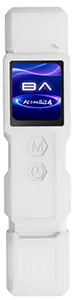
Personal/household portable water quality testers such as Water Detective 4 are intended for rapid screening and comparison of tap water, purified water, bottled water, travel water, and aquarium water, and are not suitable as a substitute for regulatory laboratory testing. It provides on-site readings of nine organic and inorganic parameters within minutes, including TOC, COD, UV254, TDS, EC, turbidity, hardness, salinity, and temperature. It is suitable for household users to establish "raw water—treated water" comparison records, and for water purification service personnel to make quick comparisons before and after filter replacement. However, it must be clear: portable readings cannot prove that drinking water is safe, nor can they prove that a specific contaminant has been removed; hardness and salinity are estimates based on conductivity, affected by water matrix, temperature compensation, and calibration conditions, and can only be used for trend observation [2].
In other words, a water quality tester is a "change recorder," not a "remaining-life calculator." If readings show no obvious change, it does not mean the manufacturer-recommended replacement time can be postponed indefinitely; if readings worsen, it does not necessarily mean a filter has failed—it could be raw water fluctuation or testing method error.
Home Maintenance Checklist
- Establish a baseline: After installing a new filter, flush until stable, then record the TDS/EC, turbidity, and temperature of raw water and treated water as your household baseline.
- Fix testing conditions: Sample weekly or biweekly at the same sampling point and with the same flushing time (e.g., flush for 30 seconds first) to reduce random error.
- Record usage data simultaneously: Installation date, average daily water usage, cumulative treated water volume, and outlet flow rate.
- Watch trends, not single points: Only after 3 or more consecutive changes in the same direction should you enter "suspected abnormality" and first communicate with the manufacturer or service provider.
- Replace when due: When the manufacturer-specified service life or treated water volume limit is reached, replace on time even if test values are still acceptable; for microbiological or specific contaminant concerns, send samples to a qualified laboratory.
When Other Tools or Laboratory Testing Are Needed
A portable tester is insufficient when you need to answer the following questions:
- Does the treated water contain specific pathogenic bacteria, viruses, or parasites?
- Are heavy metals such as arsenic, lead, and cadmium below standard limits?
- Does the drinking water meet relevant health standards or regulatory requirements?
- Does the filter's removal rate for a specific organic substance meet the standard?
These questions require certified laboratory methods, standard sampling procedures, and compliance testing. Household filters that are not replaced for a long time can also become places where bacteria breed; the CDC reminds users to maintain them according to the manufacturer's instructions and to pay attention to filter replacement timing [2]. Do not treat portable readings as a "safety promise."
Frequently Asked Questions (FAQ)
Q1: TDS rose from 30 to 50—does the filter need to be replaced immediately? A: Not necessarily. First confirm whether raw water TDS also changed, whether the water temperature is different, and whether the sampling method is consistent. A single small change is more a signal to "keep observing" than to replace immediately. Replace only if there is also a noticeable drop in flow or the manufacturer-recommended interval has been reached.
Q2: Can a water quality tester detect bacteria and viruses? A: No. Such portable devices mainly test physicochemical parameters such as conductivity, turbidity, and total organic carbon, and cannot identify microorganisms. Microbiological safety requires laboratory culture or molecular testing.
Q3: If a portable tester records treated water TDS close to raw water, does that mean the filter is not working? A: It depends on the filter type. Filtration processes such as activated carbon are not primarily designed for desalination, so small TDS changes are normal; if an RO membrane's TDS removal rate drops significantly, however, it is worth checking. Judge by comparing with the filter's claimed function.
Q4: Can hardness and salinity readings be used directly as accurate values for water hardness? A: No. Hardness and salinity in portable devices are usually estimates derived from conductivity, affected by sample matrix, temperature, and calibration; they can only be used for trend comparison and cannot replace standard methods such as laboratory titration or ion chromatography.
Conclusion
Whether a filter should be replaced is never a matter of looking at just one number. Putting service life, treated water volume, flow changes, target contaminants, and water quality trends into the same maintenance table can reduce misjudgments of "not replacing when you should" or "replacing randomly when you shouldn't." A portable water quality tester can help you spot changes and build a household water quality file, but it does not replace the manufacturer-specified replacement interval, nor does it replace compliant laboratory testing for contaminants and microorganisms. The bottom line for home maintenance is: trends are for early warning, but decisions should still come back to manufacturer guidance and necessary professional testing.
References
[1] CDC. About Choosing Home Water Filters. U.S. Centers for Disease Control and Prevention. https://www.cdc.gov/drinking-water/prevention/about-choosing-home-water-filters.html (accessed 2026-10-29)
[2] CDC. Preventing Waterborne Germs at Home. U.S. Centers for Disease Control and Prevention. https://www.cdc.gov/drinking-water/prevention/preventing-waterborne-germs-at-home.html (accessed 2026-10-29)
Discuss your application
Tell us your target parameters, water matrix, interface and annual volume. Our engineering team will recommend a practical configuration.
Request a Quote