
# Why the First Draw and Water After Flushing Should Never Be Treated as the Same
In homes and at water treatment service sites, what is most easily overlooked is not the water quality tester itself, but "whether to flush water before sampling." At the same tap, the first draw and the water after several minutes of flushing often represent completely different water segments. Mixing the two together can represent neither the risk of stagnant water in the pipes nor the state of filtered or post-flush water.
Why should the first draw and water after flushing never be treated as the same?
Water quality is a function of time and space. Water that stays in pipes, taps, filter cartridges or storage containers for different lengths of time undergoes different dissolution, precipitation, particle settling and microbial changes. The first-draw water usually includes contributions from prolonged contact between water and pipes, solder and taps; water after flushing is closer to the output after the system has been fully purged. For metal parameters such as lead and copper, laboratory sampling usually focuses on the first draw, because it is the representative sample under "worst-case" conditions[1].
If a bucket of water is casually flushed before sampling, what is collected may be a "post-flush" sample rather than a "first-draw" sample. Labeling it as "first-draw lead testing" will underestimate the risk of pipe contact and will make the laboratory results impossible to compare with assessment standards. Conversely, if the goal is only to observe the flushing effect of a water purifier but the first draw is collected, the results will also be interfered with by the pre-existing water in the pipes.
Two Sampling Purposes: Stagnant-Water Observation and Laboratory Lead Sampling
| Item | First-draw/stagnant-water sampling | Post-flush water sampling |
|---|---|---|
| Typical purpose | Assess pipe contact and metal precipitation risk; regulatory or standard sampling | Assess flushing effect, purifier output and subsequent water quality trends |
| Whether to flush before sampling | Usually no flushing; sample directly after the specified standing time | Flush first to the required duration or until water temperature stabilizes |
| Key records | Standing time, whether a filter was used, type of sampling bottle | Flushing duration, flush volume, water temperature, water source |
| Testing tools | Mainly laboratory heavy-metal/microbiological analysis; portable meters only assist with trends | Portable water quality testers can be used for trend comparison of conductivity, TDS, turbidity, etc. |
| Interpretation of results | Compare with standards or limits; requires laboratory procedures | Screening or before/after comparison only; not a compliance conclusion |
In the EPA's basic information on lead in drinking water, the focus is on identifying lead contamination in pipes, taps and soldering materials, and testing first-draw water samples is recommended[1]. The USGS National Field Manual for the Collection of Water-Quality Data also emphasizes that the sampling plan must specify before sampling "which water segment to collect, the standing or flushing conditions, and the containers and preservation methods," otherwise subsequent data will be difficult to reproduce and interpret[2].
Sampling Steps for Homes and Water Treatment Services
For household users: ask about the purpose first
- If the goal is to assess whether household pipes, taps or solder may release lead or copper, follow the first-draw sampling plan provided by the laboratory or local water utility. Usually the water must stand in the pipes long enough, then the first draw is collected directly, without pre-flushing and without removing the aerator (unless the plan requires it).
- If the goal is to check changes in conductivity, TDS, hardness or turbidity before and after filter replacement or after flushing of a water purifier, you may first flush according to the instructions and collect stable output water for trend comparison.
- The two bottles of sample must be labeled separately, clearly noting on the bottle the sampling time, whether flushing was performed, flushing duration, water temperature and whether the water passed through a purifier.
For water treatment service personnel: on-site records and repeatability
- After arriving on site, first confirm the task: is it first-draw sampling for laboratory testing, or a trend test after equipment maintenance?
- Use the same sampling point, the same container type and the same flushing conditions, repeat the measurement at least three times, and take the stable reading.
- Readings from portable water quality testers are affected by temperature and matrix. When recording readings, record the water temperature and detection mode at the same time. If the instrument shows an abnormality or the reading drifts, clean the electrode/optical window and recalibrate first; do not simply take one value and write it into the report.
When a Water Quality Tester Is Needed for Trend Comparison
Water Detective 4 is a personal/household portable water quality tester pen that integrates nine indicators — TOC, COD, UV254, TDS, EC, turbidity, hardness, salinity and temperature — in one rapid testing platform, intended for domestic water, on-site screening, water treatment services and aquaculture testing. It is suitable for answering trend comparison and on-site screening questions such as "did TDS drop after filter replacement," "does turbidity tend to stabilize at different flushing times," and "are the hardness/salinity of two water sources close?"
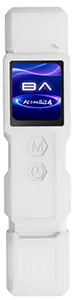
The boundary must be clearly drawn here: portable trends are not proof of drinking safety or of specific contaminants. Water Detective 4 does not include parameters such as lead, copper or microorganisms and cannot replace laboratory testing required by regulations. Hardness and salinity are estimated values, limited by water matrix and calibration; TDS and EC readings should also be compared under the same temperature conditions or after temperature compensation to improve repeatability.
When Testing Must Return to the Laboratory
In the following situations, do not treat portable meter readings as conclusions:
- Suspected specific contaminants such as lead, copper, arsenic, disinfection by-products or bacteria;
- A determination is needed as to whether the water meets drinking water standards;
- The sample will be used for complaints, arbitration, engineering acceptance or government spot checks;
- On-site readings are abnormal, but sampling, cross-contamination or instrument drift cannot be ruled out.
In these scenarios, follow the USGS NFM approach: first clarify the sampling purpose, then select compliant containers, preservatives and transport methods, and send the sample to a qualified laboratory for analysis[2]. Household users can contact the local CDC, water utility or an accredited laboratory to obtain first-draw sampling bottles and written sampling instructions.
Actionable checklist
- [ ] Before sampling, write down the purpose: first-draw/stagnant water, or post-flush/after rinsing?
- [ ] First-draw sampling: no pre-flushing; after the specified standing time, collect the first draw; post-flush sampling: flush according to the plan, then collect.
- [ ] Keep the two sample bottles separate and label the time, flushing conditions and water temperature.
- [ ] For on-site trend testing, repeat 3 times under the same conditions and take the stable value.
- [ ] Hardness and salinity results are estimates only; do not draw direct conclusions across water sources.
- [ ] In the report, clearly state whether it is "trend screening" or "laboratory submission"; the two cannot be interchanged.
FAQ
Q: I have a Water Detective 4 at home. Can I determine on my own whether lead exceeds the limit? A: No. Water Detective 4 does not include lead detection parameters and does not have the sample preparation, quality control and analysis capabilities of a regulatory laboratory. Lead testing must follow EPA or local regulations to collect a first-draw water sample and send it to a laboratory for analysis[1].
Q: Why might TDS be lower after flushing than in the first draw? A: This is usually because the first draw stays longer in the pipes or tap and dissolves more substances; after flushing, fresh water enters and TDS/EC changes. This change only indicates a trend and cannot prove "safe" or "unsafe."
Q: Can first-draw and post-flush samples be mixed in one bottle? A: No. The two represent different water segments; mixing them loses the first-draw contact information and the flushing-effect information, and the laboratory cannot assess them according to the original purpose.
References
[1] US EPA. Basic Information about Lead in Drinking Water. https://www.epa.gov/ground-water-and-drinking-water/basic-information-about-lead-drinking-water (accessed: 2026-05-07)
[2] USGS. National Field Manual for the Collection of Water-Quality Data. https://www.usgs.gov/mission-areas/water-resources/science/national-field-manual-collection-water-quality-data-nfm (accessed: 2026-05-07)
Discuss your application
Tell us your target parameters, water matrix, interface and annual volume. Our engineering team will recommend a practical configuration.
Request a Quote