
# How NSDD6 Supports Early Screening of Abnormal Wastewater Inflow: COD Sensor and Multiparameter Trends
Why Abnormal Inflow Requires Early Trend Screening
The influent of municipal and industrial park wastewater treatment plants is usually collected from multiple nodes, including domestic sewage, industrial pretreatment effluent, rainwater pipe cross-connections and pumping station inflow. Any abnormality at any point can enter the treatment system as an "influent shock", causing sludge load fluctuations, effluent exceedance or biological system inhibition. Traditional laboratory COD and TOC analysis is usually sampled per shift or per day, with a lag of hours to days, which cannot meet the need for minute-level event detection.
The NSDD6 industrial multiparameter water quality sensor continuously monitors key parameters such as TOC, COD, UV254, color and turbidity, helping operations teams identify abnormal inflow worth prioritizing from background fluctuations. It is an on-site rapid screening device and cannot replace laboratory analysis, but it can focus limited laboratory resources on truly suspicious periods. For online water quality monitoring systems, this multiparameter trend is more valuable than a single-point reading because it can distinguish "normal fluctuation" from "abnormal deviation".
The Boundaries of NSDD6: On-Site Screening, Not a Laboratory Replacement
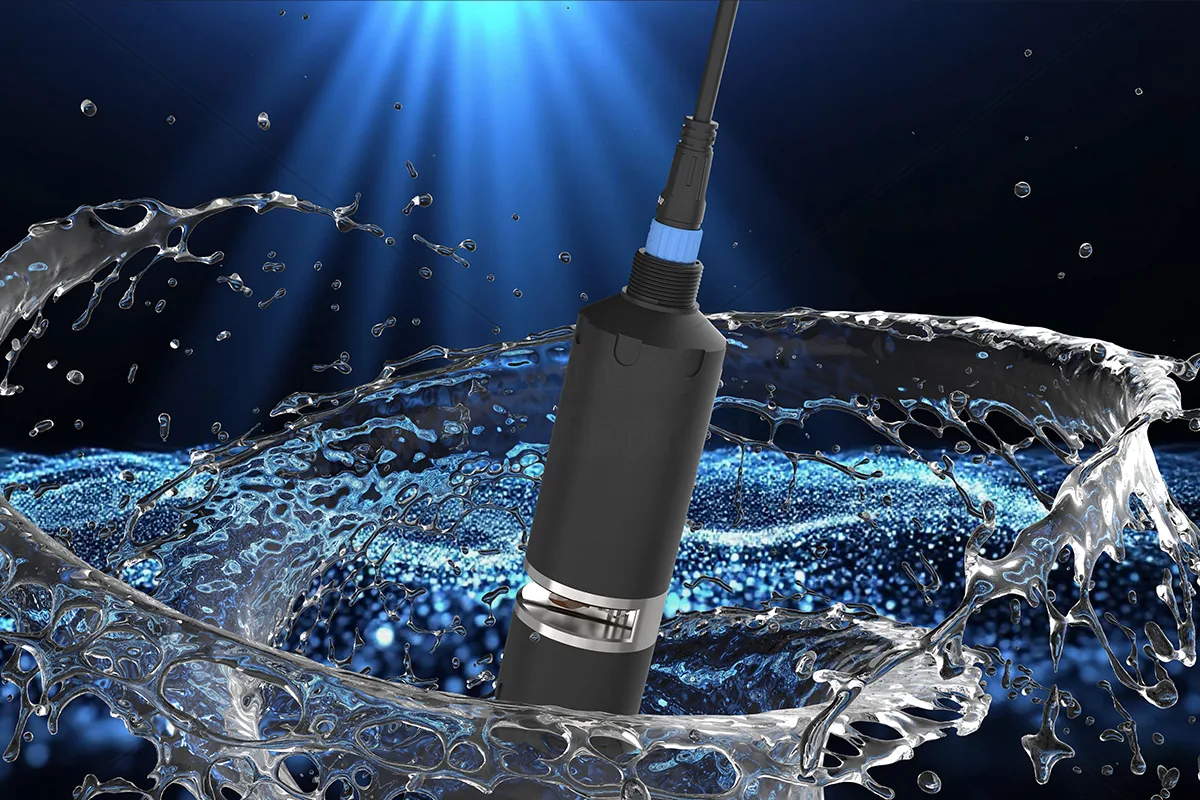
The NSDD6 is a reagent-free, non-contact spectral measurement multiparameter water quality sensor that can simultaneously output up to six indicators: TOC, COD, turbidity, color, UV254 and temperature. Its automatic physical cleaning function supports long-term field or wastewater environment deployment, and the 316L stainless steel and POM construction is suitable for industrial sites. RS485 isolated communication facilitates integration into existing PLC or SCADA systems.
It should be particularly noted that the COD, TOC and other outputs of the NSDD6 are indirect spectral measurement values. The organic composition, color, turbidity and temperature of different water samples all affect the spectral response, so online values must be calibrated through site-specific correlation to establish a comparison with laboratory methods. It is suitable for trend alarms, process optimization and abnormal monitoring at discharge outlets, but not suitable for direct use as legal discharge reporting data. This boundary is very important for engineering procurement and O&M personnel: do not assume that because the device is called a COD sensor it is equivalent to a laboratory COD analyzer.
How to Cross-Confirm Abnormal Inflow Using a COD Sensor and Multiparameter Trends
A single online parameter is easily disturbed. For example, a COD sensor may fluctuate due to changes in chloride, color or turbidity that are not caused by organic load. The NSDD6 simultaneously provides parameters such as TOC, UV254, color and turbidity, enabling operators to perform cross-validation and reduce false alarms.
| Parameter | Typical Meaning of Change | On-Site Judgment Points |
|---|---|---|
| COD | Comprehensive trend of oxidizable substances under aerobic conditions | Compare with TOC trend to determine whether it mainly comes from organic matter |
| TOC | Total organic carbon, directly reflecting organic load | Changes in the ratio to COD indicate changes in organic matter type |
| UV254 | Organic matter containing aromatic rings and unsaturated bonds | Industrial wastewater and humic substances may rise significantly |
| Color | Color-causing substances, such as dyes and metal ions | A rise alone may come from colored industrial water |
| Turbidity | Suspended particulate matter | Check rainfall, pipe scouring or sampling disturbance |
Common combination patterns:
- TOC and UV254 rise, turbidity stable: dissolved organic matter increases; focus on investigating industrial organic wastewater or landfill leachate intrusion.
- COD and turbidity rise, UV254 does not rise: may be inorganic reducing substances, sediment or highly colored particles; manual sampling is needed for confirmation.
- Color and UV254 change simultaneously: colored industrial wastewater (such as printing and dyeing, papermaking) is a key suspect.
- Only temperature changes briefly: may be cooling water or industrial hot water discharge; judge in combination with other parameters and upstream pumping station records.
This combination logic is not a fixed formula, but helps engineers determine sampling and investigation priorities. It should be noted that some industrial wastewater may change multiple parameters at the same time, so interpretation must be combined with historical data and upstream sources.
Implementation Steps: From Baseline to Event Closure
1. Establish a Site Baseline
After installing the NSDD6, it should run continuously for at least 7–14 days, covering different conditions such as normal work, weekends, rainfall and upstream discharge. Calculate the typical range, diurnal pattern and rainfall response of each parameter. The baseline is used to distinguish "normal fluctuation" from "abnormal deviation" and does not require absolute standard values.
2. Set Relative Change Alarms
It is not recommended to copy fixed thresholds from other plants. It is recommended to use the baseline median or rolling average as a reference and set relative change rate alarms, for example triggering a prompt when deviating from the baseline by 30%–50%. The specific proportion should be adjusted according to the historical fluctuation range at that point, false alarm tolerance and operator response speed. This process needs to be recorded and reviewed regularly to avoid thresholds that are too loose or too tight.
3. Multiparameter Logic Judgment
When multiple related parameters deviate from the baseline at the same time, event credibility is higher. Simple rules can be defined:
- TOC and COD rise simultaneously: organic load shock.
- UV254 and color rise simultaneously: possibly colored industrial wastewater.
- Only turbidity rises suddenly: check rainfall scouring, pipe sediment or disturbance near the sampling port.
- Brief abnormal temperature change: may be accompanied by cooling water or industrial hot water discharge; judge in combination with other parameters.
4. Manual Confirmation and Log Closure
Automatic alarms are only screening signals. Operators should:
- Review historical trends and data before and after the alarm;
- Collect representative water samples during the alarm period and send them to the laboratory for COD, TOC or characteristic pollutant analysis;
- Investigate in combination with upstream enterprise discharge records, pumping station operation and weather conditions;
- Record confirmed results together with sensor data in the process log.
Only after manual confirmation is completed and written into the log is the event considered closed. Sensor trends are used for prompts and cannot replace on-site investigation.
Key Points for NSDD6 Installation and Data Integration
- Installation location: in a straight pipe section after the influent screen and before or after the grit chamber, avoiding bubbles, dead water and heavy suspended solids deposition.
- Immersion depth: ensure the measurement window is in a representative flow according to the manufacturer's installation requirements.
- Cleaning and maintenance: automatic physical cleaning can handle routine fouling, but manual inspection should be arranged in high-grease or scaling water.
- Data connection: the RS485 isolated signal can be connected to PLC, RTU or SCADA for linked analysis with flow meters and pumping station operation data.
- Power supply and grounding: wire according to electrical specifications to ensure stable long-distance communication.
General Method for Site-Specific Correlation Calibration
Although the NSDD6 requires no reagents, in order to convert online spectral signals into more reliable COD or TOC trends, site-specific correlation calibration is recommended:
- Select different conditions such as normal, low load and high load, and collect laboratory water samples simultaneously.
- Regress laboratory results against the NSDD6 spectral response at the same time to establish a local model.
- Regularly (for example monthly or seasonally) check model deviation with new laboratory data.
- When the water sample type changes significantly (such as enterprise shutdown or new pipeline connections), re-evaluate the correlation.
This process is not a one-time task, but the key to ensuring the effectiveness of trend alarms. Absolute value alarms without correlation are prone to many false alarms or missed alarms.
Limitations and On-Site Verification
The non-contact spectral measurement of the NSDD6 is suitable for long-term trend monitoring, but not all water samples can produce results consistent with the laboratory. Strong color, high turbidity or special industrial wastewater may cause spectral interference and require site calibration or model correction. Automatic physical cleaning can reduce biofilm and particulate attachment, but in high-grease and high-scaling environments the measurement window still needs regular manual inspection.
Temperature changes also affect spectral response and chemical reactions in water, so temperature data should be recorded during long-term operation and baseline drift should be evaluated in combination with seasonal changes. It is recommended to compare online data with laboratory methods at least once a month, or to add water sample verification after each abnormal event. Comparison results should be used as the basis for adjusting alarm thresholds and maintenance cycles.
Any online sensor may produce false alarms and missed alarms. False alarms waste manpower, while missed alarms may miss shocks. Multiparameter logic and baseline learning can reduce the probability of both, but cannot completely avoid them. Therefore, the system should allow manual event marking and continuously optimize alarm rules.
FAQ
Q: Can the COD sensor value of the NSDD6 be used directly for environmental compliance determination? A: No. The COD of the NSDD6 is a rapid spectral screening value used for trend warning and process management. Compliance determination should be based on laboratory standard methods recognized by the local environmental protection department.
Q: Why does COD sometimes rise but TOC is not obvious? A: This may be because the water sample contains more reducing inorganic substances, or the organic composition has changed, and the spectral model responds differently to this type of water sample. In this case, UV254, color and manual sampling analysis should be combined.
Q: How does installation location affect early investigation? A: A representative section after the influent screen and before or after the grit chamber should be selected, avoiding dead water zones, bubbles and obvious sediment. An unstable installation location will increase data noise and affect trend judgment.
Q: Can automatic cleaning completely eliminate maintenance? A: No. Automatic physical cleaning can reduce the frequency of manual maintenance, but the measurement window still needs regular inspection, especially in high-pollution-load or scaling-prone water.
Discuss your application
Tell us your target parameters, water matrix, interface and annual volume. Our engineering team will recommend a practical configuration.
Request a Quote