
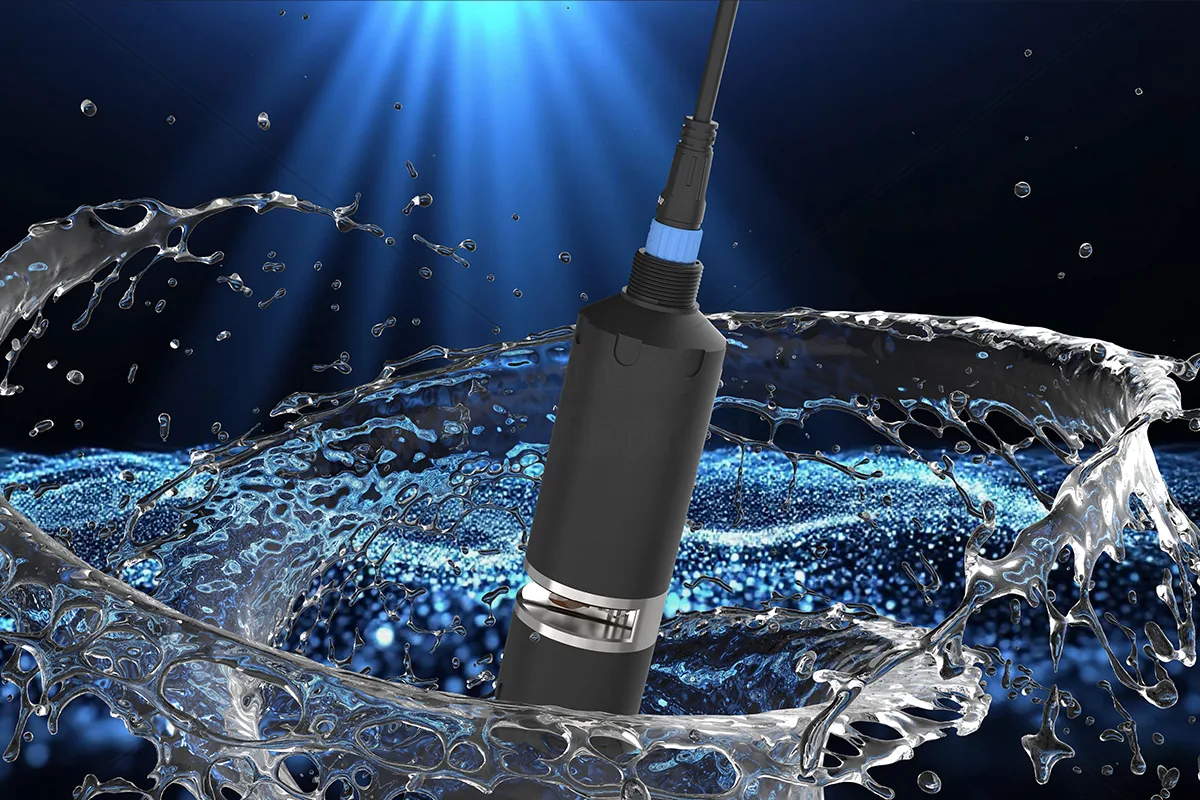
In industrial reuse water projects, online water quality monitoring instruments such as COD sensors, TOC sensors and UV254 sensors are increasingly used for trend warning. But one premise must be clear: online spectral sensors are used for trend screening and process control, and are not equivalent to laboratory compliance analysis. The NSDD6 is a reagent-free industrial multi-spectral water quality sensor, which can also be regarded as a multiparameter water quality sensor, capable of simultaneously outputting six parameters: TOC, COD, turbidity, color, UV254 and temperature. Using the NSDD6 as an example, this article explains how to turn a single reading into trend information, and how to build a reliable industrial reuse water trend monitoring method through reference-method verification and process-event correlation.
1. First define the trend objective clearly
Industrial reuse water projects usually care about four types of issues: organic load shocks, changes in treatment unit efficiency, water quality fluctuations before/after the membrane, and abnormal discharge events. The goal of online trend monitoring is not to obtain an absolute COD value, but to define an actionable water quality change curve.
The following three types of trend indicators are recommended:
- Baseline: run continuously for one complete process cycle and record the reading range under normal conditions.
- Deviation band: set the normal fluctuation range based on historical standard deviation or percentiles.
- Alarm rules: combine over-limit, rate of change and continuous over-limit duration to avoid false alarms from a single threshold.
For example, during normal operation of a reuse unit, the COD trend fluctuates around a certain range; when there is a continuous rise or step change lasting more than 30 minutes, an early warning should be triggered even if the discharge limit has not yet been exceeded. Specific thresholds must be determined according to on-site water quality and process, and generic values should not be copied directly.
2. Key node placement: choose points from the process profile
Online monitoring must be placed where it can represent water quality changes, not where installation is convenient. The NSDD6 uses a 316L stainless steel and POM industrial structure and has automatic physical cleaning, making it suitable for longer continuous deployment, but the choice of installation point still determines the value of the data.
Common reuse water monitoring nodes are shown in the table below:
| Process node | Monitoring purpose | Parameters to watch |
|---|---|---|
| Influent/equalization tank | Identify influent shocks and load fluctuations | COD, TOC, turbidity, color |
| After pretreatment | Evaluate coagulation, sedimentation or filtration performance | Turbidity, color, COD |
| Before/after biological or advanced treatment | Judge unit removal efficiency and stability | COD, TOC, UV254 |
| Before the reuse point | Confirm the final reuse water trend | COD, turbidity, color |
During installation, avoid dead zones, strong bubbles, strong shadows and severe turbulence. If on-site suspended solids are high, set the automatic cleaning cycle according to the actual degree of contamination and perform regular manual maintenance.
3. A reading is not a conclusion: verify with reference methods
This is the most easily overlooked part of industrial reuse water trend monitoring. The NSDD6 outputs trend values converted from a spectral model, and the relationship with laboratory standard methods (such as the COD dichromate method and the TOC combustion method) is not a simple equals relationship, but a method correlation relationship.
The differences between the two are mainly reflected in:
- Organic matter composition differs among wastewaters from different industries, and spectral response may differ.
- Color and turbidity interfere with optical measurement and require local calibration.
- Long-term operation of online sensors may involve drift.
Therefore, a dual-track system of on-site screening plus laboratory confirmation must be adopted:
- At initial installation and during operation, periodically collect parallel water samples at the same time and send them to the laboratory for analysis.
- Establish a local correlation model or calibration curve, covering low, medium and high concentration ranges.
- Use online readings only for trend judgment and process control; any external report or compliance judgment must be based on laboratory reports.
4. Correlate process events to form a closed loop
A trend curve itself is only data. Only by correlating the curve with process operation logs can you answer why it changed and whether treatment is needed.
The following events should be included in the timeline:
- Chemical dosage adjustment
- Backwash/chemical cleaning
- Production batch switching
- Equipment maintenance or reflux changes
- Influent water source switching
When the COD trend shows a step or spike, first check process events within the same time window. If the anomaly coincides with a certain operation, it can be attributed to the operational impact; if there is no corresponding event, it may be an unknown discharge or equipment abnormality. The NSDD6 has long-distance isolated RS485 communication and can be connected to PLC/SCADA to record trends and process parameters synchronously for retrospective analysis.
5. Implementation steps: a practical selection and verification process
For system integrators and technical buyers, it is recommended to proceed in the following order:
- Clarify the purpose: confirm whether the project is for early warning, process optimization or trend recording, and avoid mistaking online equipment for a compliance instrument.
- Choose the parameter combination: select the necessary items from the NSDD6's TOC, COD, turbidity, color, UV254 and temperature according to water quality characteristics.
- Confirm installation conditions: check flow regime, installation location, power supply and communication.
- Establish a baseline: run continuously for at least one complete process cycle and record normal fluctuations.
- Reference method comparison: collect at least low, medium and high concentration water samples, compare with laboratory methods, and establish a local model if necessary.
- Set alarm rules: use combined logic of baseline + rate of change + duration.
- Regular review: check cleaning effectiveness, signal drift and the validity of the local model.
6. Limitations and applicable boundaries
The NSDD6 is a reagent-free, automatically cleaned online multi-spectral water quality sensor, but it has clear boundaries in application:
- Cannot replace laboratory standard methods: online data is only for trend screening and process control.
- Affected by matrix: industrial wastewater composition varies greatly, and a single model cannot cover all scenarios.
- Interference factors: color, turbidity, bubbles, temperature, etc. may affect the spectral signal and require local calibration and on-site experience.
- Maintenance requirements: automatic physical cleaning can delay contamination, but manual inspection and cleaning are still required in high-oil, high-scaling and high-suspended-solids scenarios.
- External reporting: if online data must be cited, it should be labeled as online screening/trend data and accompanied by laboratory verification.
7. Difference between trend monitoring and compliance analysis
| Comparison dimension | Online trend monitoring (NSDD6) | Laboratory compliance analysis |
|---|---|---|
| Purpose | Process warning, trend analysis | Compliance determination, statutory reporting |
| Method | Non-contact spectral measurement, reagent-free | Standard methods, such as the dichromate method |
| Output | Continuous multiparameter trend values | Single-batch result |
| Time | Real-time/near real-time | Hours to days |
| Calibration method | Local correlation model or calibration curve | Standard samples, blanks, duplicate samples |
| Legal validity | Generally cannot be used alone as compliance evidence | Is the primary basis for compliance determination |
FAQ
Q1: Can NSDD6 online COD readings be used directly as the basis for discharge compliance?
No. Online multispectral sensors are trend-screening devices. Compliance determination must use laboratory standard methods and follow local regulations and quality control requirements.
Q2: Why can NSDD6 output multiple parameters such as TOC, COD and UV254 simultaneously?
It uses non-contact spectral measurement to obtain the spectral characteristics of the water sample in specific wavelength bands, and then converts them into multiple indicators through built-in models. Actual applicability needs to be verified locally according to the specific water quality.
Q3: How can industrial reuse water projects reduce false alarms in online monitoring?
Do not rely only on a single over-limit threshold. It is recommended to use a combination of "baseline + rate of change + continuous duration + process event correlation" rules, and regularly calibrate with laboratory data.
Q4: At which industrial reuse water points is NSDD6 suitable for installation?
Representative flow locations such as intake/adjustment tank, after pretreatment, before and after biological/advanced treatment, and before the reuse point. Installation points should avoid dead zones, bubbles and severe turbulence.
Discuss your application
Tell us your target parameters, water matrix, interface and annual volume. Our engineering team will recommend a practical configuration.
Request a Quote