
# Interface Planning for NSDD6 in Wastewater Treatment Plant Expansion Projects: COD Sensor Integration Points
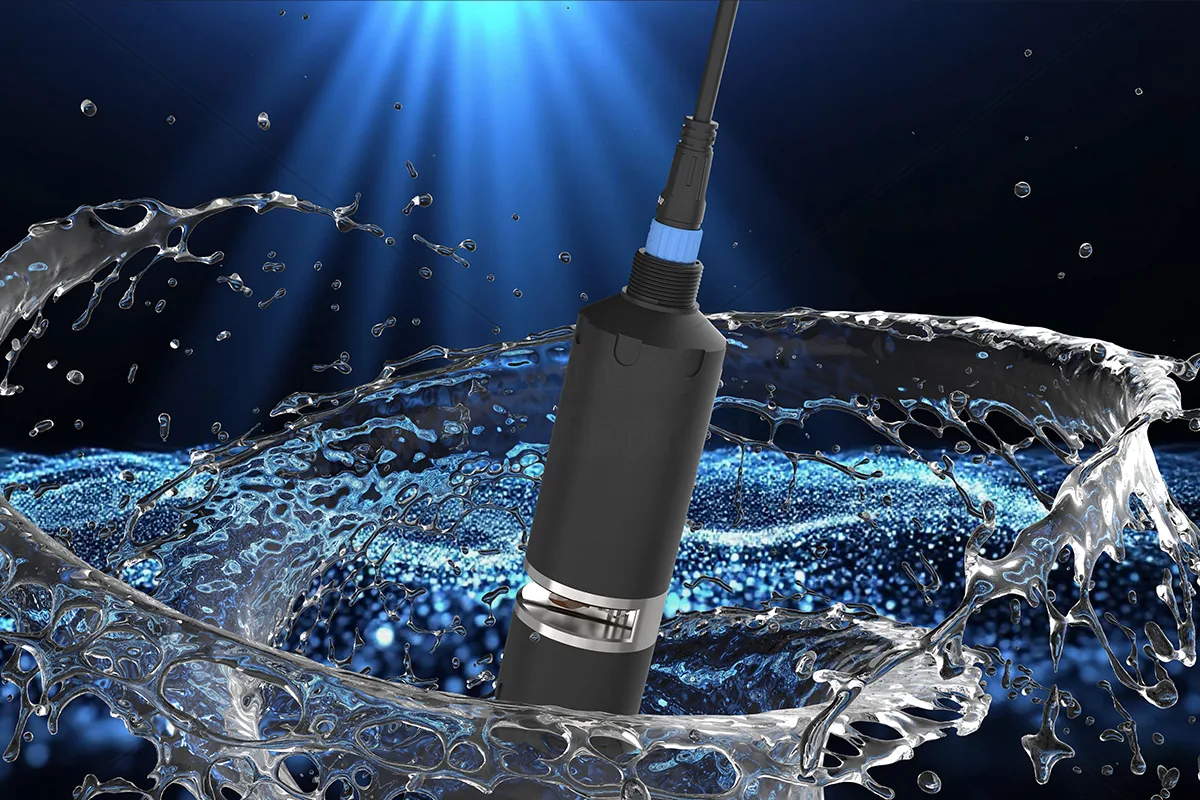
Wastewater treatment plant expansion projects often require process switching and instrument integration to be completed without shutting down production or with only short-term water stoppage. Continuous online water quality monitoring is an important support for ensuring stable effluent compliance after expansion. The NSDD6, as a multispectral water quality sensor, can simultaneously output six parameters — TOC, COD, turbidity, color, UV254 and temperature — using non-contact spectral measurement without chemical reagents, and features automatic physical cleaning, making it suitable for long-term deployment at locations such as plant inlet, biochemical tank and secondary clarifier effluent. This article provides interface planning recommendations for the NSDD6 in wastewater treatment plant expansion projects from five aspects: measurement point reservation, control system interfaces, construction phase, commissioning window, and acceptance and handover documentation.
I. Measurement Point Reservation Design in Expansion Projects
In wastewater treatment plant expansion, spatial and pipeline conflicts often exist between new process units and existing structures. If online sensor interfaces are not reserved in advance, later drilling and cable laying will significantly increase the risk of water stoppage. Therefore, the installation location and reservation conditions for the NSDD6 should be specified during the preliminary design or construction drawing stage.
Typical monitoring nodes include: main inlet, primary clarifier effluent, biochemical tank, secondary clarifier effluent, advanced treatment effluent, and main outfall. Each node can use one or more NSDD6 units for different process purposes. Since the NSDD6 uses non-contact spectral measurement, it has certain requirements for flow conditions: locations with stable flow velocity, no obvious bubbles and no sediment accumulation should be selected, avoiding strong aeration zones, drop zones and dead water zones. In expansion projects where channels or distribution wells are used, dedicated flow-through cells or bracket mounting can be given priority.
Reservations should include at minimum: mounting brackets or mounting flanges, DC power supply cables, RS485 communication cables, lightning protection and grounding terminals, and maintenance access. The NSDD6's 316L stainless steel and POM construction can adapt to wastewater environments, but mounting brackets still require anti-corrosion treatment. Automatic physical cleaning can reduce manual desilting, but sufficient space should be reserved around the sensor for periodic inspection of the optical window and cleaning mechanism.
The measurement point reservation plan should be jointly confirmed with civil, process and electrical disciplines at design coordination meetings, and the sensor model, installation location, cable routing and power requirements should be marked on drawings. The following table presents several typical monitoring locations and interface planning points:
| Monitoring Location | Primary Purpose | Relevant Parameters Available from NSDD6 | Interface Planning Points |
|---|---|---|---|
| Main Inlet | Inlet load warning and process front-end control | COD, TOC, UV254, color, turbidity | Reserve RS485 and power points; signal connected to pretreatment unit or PLC |
| Biochemical Tank | Aeration optimization and anomaly warning | COD, TOC, UV254, temperature | Select representative area; avoid strong aeration interference; reserve maintenance platform |
| Secondary Clarifier Effluent | Effluent trend monitoring and downstream process interlocking | COD, UV254, turbidity | Avoid scum and effluent weir drop interference; periodic laboratory comparison |
| Main Outfall | Internal trend monitoring, not for compliance data | COD, UV254, TOC, turbidity | Reserve compliance monitoring instrument interface; NSDD6 for internal warning only |
II. Control System Interface Planning
The NSDD6 outputs data through a long-distance isolated RS485 communication interface, suitable for connection to PLC, RTU or SCADA systems commonly used in wastewater treatment plants. In expansion projects, network compatibility with existing and new control systems, address planning and data refresh cycles need to be considered.
RS485 is half-duplex multi-point communication; multiple sensors can typically be connected on one bus, but the actual topology and terminating resistors need to be designed according to site conditions. The NSDD6's isolation characteristics help suppress ground loop interference, but in long-distance or complex electromagnetic environments, shielded twisted pair is still recommended, and communication cables should be routed in separate trays from power cables. If the existing control system only supports 4–20 mA or Ethernet, signal conversion gateways or communication management units need to be added, but such conversion is not a function of the NSDD6 itself and requires separate configuration.
On the SCADA side, data points should be established with one-to-one correspondence to physical sensors, specifying the engineering units, range and alarm deadband for each parameter. The NSDD6 outputs six parameters — TOC, COD, turbidity, color, UV254 and temperature — with high data density, requiring collection cycles and storage strategies to be set according to process control requirements. For key points such as the inlet COD sensor, rate-of-change alarms and over-limit alarms are recommended, combined with process operating status for suppression to avoid false alarms during flushing, sampling or maintenance.
III. Construction Phase Precautions
The main risks during the construction phase come from mechanical damage, water ingress and electrical interference. During NSDD6 installation, the optical window should be protected from impact, and sharp tools must not be used to clean the sensor surface. The automatic physical cleaning device should undergo operational testing before installation to confirm the cleaning brush or wiper operates normally and does not obstruct the optical path.
Cable laying should follow the principles of "separating power and signal cables, shielded grounding, and waterproof sealing." Shielded twisted pair is recommended for RS485 cables, with the shield grounded at a single point on the control cabinet end to avoid ground loops. Cable connectors at the sensor end should be waterproofed to prevent wastewater from entering the terminal chamber. Expansion sites often have welding, cutting and other operations; if the sensor is not commissioned immediately after installation, temporary protective measures should be taken, and inspections should be conducted before removing packaging.
IV. Commissioning Window and On-Site Verification
Commissioning should be scheduled during periods when the process is operating stably and representative water samples can be collected. Dry season or typical load days should be given priority, covering at least one complete diurnal variation cycle. Commissioning content mainly includes communication testing, cleaning cycle verification and numerical stability observation.
Communication testing requires confirming that each NSDD6's address, baud rate and data format match the host computer settings, and that all six parameters can be read continuously. Cleaning cycle verification can simulate scaling conditions and observe numerical recovery before and after automatic cleaning. Since the NSDD6 uses non-contact spectral measurement, its output values are significantly affected by the water sample matrix. Therefore, on-site verification must include laboratory comparison: water samples should be collected at the same sampling point, and correlation analysis should be conducted using laboratory standard methods (such as the national standard COD method) and NSDD6 online readings separately. The comparison process should cover different load and turbidity conditions to establish local correction coefficients or models.
It must be clarified: the COD sensor readings from the NSDD6 are process analysis signals used for trend monitoring and anomaly warning, and cannot directly replace laboratory testing as compliance discharge data. The commissioning report should state the comparison method, sample quantity, correlation coefficient and applicable boundaries.
V. Acceptance and Handover Documentation
Acceptance should aim for "long-term stable operation with traceable data," focusing on checking the following: whether installation locations comply with the design, whether power supply and communication are reliable, whether the cleaning mechanism operates normally, whether data refresh meets requirements, whether the comparison report is complete, and whether alarm thresholds are reasonable.
Handover documentation should include: sensor data sheets, interface wiring diagrams, parameter address mapping tables, commissioning records, water sample comparison reports, maintenance procedures and spare parts lists. Operations personnel should understand that although automatic cleaning can reduce maintenance pressure, the sensor still needs to be periodically removed to inspect the optical window, and soft cloth and anhydrous ethanol should be used for cleaning when necessary; hard objects must not be used to scrape it.
VI. Limitations and Engineering Boundaries
Online spectral sensors offer advantages in wastewater treatment plant applications such as fast response, no reagents and low maintenance, but have inherent limitations. Water sample matrices vary greatly across different wastewater treatment plants and process stages, and a fixed spectral model may not accurately cover all water quality variations. Therefore, the NSDD6 is more suitable for continuous trend monitoring, process warning and optimization control, and should not be used as a direct basis for environmental acceptance or enforcement monitoring.
In addition, automatic physical cleaning can delay biofilm and particulate attachment but cannot completely replace manual cleaning. In scenarios with severe grease and calcium scaling, periodic manual intervention is still required. At the communication level, the NSDD6 provides an RS485 interface, but the specific communication protocol, register definitions and parsing methods must be confirmed with the manufacturer or system integrator; plug-and-play should not be assumed. Sufficient commissioning time should be reserved during planning to avoid hasty comparison before production startup.
FAQ
Q: Can the NSDD6 directly output COD values compliant with national standards?
A: The NSDD6 provides COD sensor measurement signals, but as a non-contact spectral online device, its readings require correlation established through on-site water sample comparison with laboratory standard methods (such as the national standard method), and are only suitable for trend monitoring and warning; they cannot directly replace laboratory testing as a compliance basis.
Q: In an expansion project, how can the existing RS485 network be connected to the NSDD6?
A: The communication parameters and address allocation of the existing network need to be confirmed; shielded twisted pair should be used with proper grounding, avoiding shared cable trays with variable frequency drives and high-power equipment. The NSDD6's isolated RS485 interface helps reduce interference, but if the distance is too long or there are too many nodes, repeaters or signal isolators should be added.
Discuss your application
Tell us your target parameters, water matrix, interface and annual volume. Our engineering team will recommend a practical configuration.
Request a Quote