
Introduction
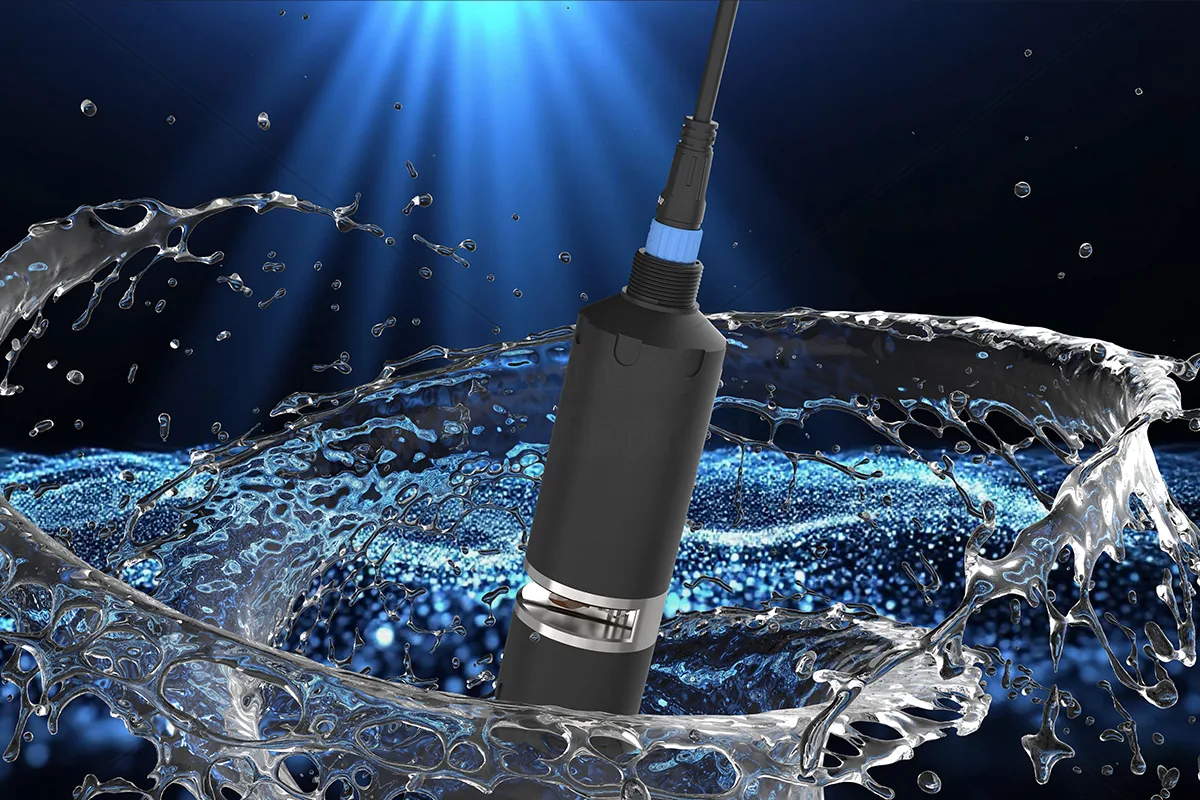
The NSDD6 is an industrial multispectral sensor designed for continuous water quality trend monitoring. Its core features include reagent-free, non-contact spectral measurement and automatic physical cleaning, making it suitable for long-term online monitoring of surface water, industrial and domestic wastewater, treatment plant effluent, and discharge outlets. However, it is not a "compliance tester," and its engineering boundaries must be understood before selection.
Application Scenarios
Based on selected applications in the database, the NSDD6 is primarily suitable for the following two scenarios:
Wastewater Treatment
In wastewater treatment plants, the NSDD6 can be used for influent shock warning, biological tank operation trends, secondary clarifier and effluent water quality monitoring, providing operators with high-density data to assist in adjusting aeration rate, return ratio, and chemical dosing. Continuous monitoring of trends in TOC, COD, turbidity, color, and other parameters helps promptly detect influent anomalies or process fluctuations.
Industrial Process Water
For equipment manufacturers, automation systems, and water-consuming production processes, the NSDD6 can be embedded as a digital sensor in water circulation, cooling, washing, or discharge pretreatment stages to achieve water quality monitoring and warning. Its RS485 digital interface facilitates integration into PLCs, SCADA systems, or industrial IoT gateways.
Selection Boundaries: Water Sample Matrix, Installation Location, and Decision Methods
Water Sample Matrix Assessment
Multispectral measurement relies on the optical path between the optical window and the water body, and is affected by color, turbidity, particulate matter, bubbles, oil films, and the composition of dissolved organic matter. For relatively stable municipal wastewater and surface water, trend consistency is generally good; however, high-concentration industrial wastewater or wastewater with strong color or complex organic matter may lead to increased spectral model deviation. Before selection, representative water samples should be collected for field comparison over a period to confirm the correlation between sensor output and laboratory reference methods. Do not assume all water bodies are suitable.
Installation Location
Choose a pipe section or open channel with uniform mixing, stable flow velocity, no obvious bubble accumulation, and no strong direct light interference. Avoid areas with sedimentation dead zones, intense aeration, or large amounts of floating debris. Automatic physical cleaning can inhibit biofilm and particle deposition on the window, but cannot eliminate highly viscous oil or hard scale; the installation location should still be convenient for manual inspection. The sensor uses a 316L stainless steel and POM industrial structure, which is suitable for general wastewater and industrial environments, but cannot be equated with suitability for any corrosive medium.
Decision Methods
A four-step decision approach is recommended:
- Clarify the monitoring purpose: process trends, warnings, energy optimization, or compliance proof? If it is for compliance discharge reporting, any online optical sensor can only serve as a screening tool.
- Assess the stability of the water sample matrix: whether organic composition, turbidity, color, and temperature fluctuations are severe, and the dispersion of historical laboratory data.
- Confirm installation and maintenance conditions: whether the installation point is representative, convenient for regular cleaning and calibration; whether RS485 wiring distance and connection environment meet industrial isolation requirements.
- Plan verification and calibration: determine the frequency of laboratory comparison, calibration methods, and data anomaly handling procedures.
Implementation Steps
- Installation: Install the sensor at the selected location, ensuring the optical window matches the water flow direction, avoiding the window facing bubbles or large particles. The installation method should prevent sediment from covering the window and facilitate disassembly for inspection. Refer to the product manual for specific installation dimensions and connection methods.
- Wiring and Integration: Connect to a PLC, RTU, or industrial PC via the long-distance isolated RS485 interface for data acquisition. RS485 isolation helps suppress ground loop interference and is suitable for long-distance wiring in industrial environments. Configure communication parameters and data registers according to the product manual.
- Cleaning and Maintenance: Enable the automatic physical cleaning function and adjust the cleaning frequency based on on-site pollution trends. Regularly perform manual inspection of the window for residual oil film, scale, or scratches; check whether the cleaning mechanism is jammed; and ensure seals are intact.
- Data Verification: During initial commissioning and regular maintenance, collect on-site water samples and send them to the laboratory for analysis. Compare laboratory TOC, COD, turbidity, and other results with sensor output to establish or update on-site calibration curves. If trends are abnormal, immediately confirm with laboratory methods.
Limitations
- Non-standard method: NSDD6 output is based on spectral models, not GB or ISO standard test methods, and cannot be used as direct evidence for discharge compliance reporting.
- Cross-sensitivity: There is spectral overlap among turbidity, color, and organic pollution; a single model may be subject to interference. The greater the change in water composition, the higher the risk of deviation.
- Maintenance dependency: Automatic physical cleaning reduces the frequency of manual cleaning but cannot fully eliminate maintenance; optical window contamination, biofilm, oil, etc., may still affect measurements.
- Environmental limitations: Extreme temperatures, strongly corrosive media, high concentrations of suspended solids, or oily wastewater may exceed the sensor's applicable boundaries and require careful evaluation.
- Data interpretation: The sensor provides trends and warnings; alarm signals must be confirmed by retesting in a qualified laboratory.
Verification methods
It is recommended to establish a two-tier system of "on-site screening + laboratory confirmation":
- Regular comparison: Develop a laboratory sampling plan based on process fluctuations and maintenance cycles, taking at least duplicate samples each time, and record auxiliary parameters such as water temperature and conductivity.
- Linear regression and deviation analysis: Perform regression of sensor output against laboratory reference values, checking slope, intercept, correlation coefficient, and residual distribution; if correlation decreases or deviation drifts, check for window contamination, optical path shift, or changes in water composition.
- Sample retention for review: For abnormal water samples flagged by the sensor, retain samples and send them to the laboratory for testing within the validity period, avoiding process or compliance decisions based solely on trend data.
- Third-party verification: If data is to be used for environmental regulation or external reporting, testing should be conducted by a qualified laboratory using current standard methods, with the sensor serving only as auxiliary monitoring.
Frequently Asked Questions (FAQ)
Q1: Can the NSDD6 be directly used as a COD/TOC discharge compliance tester? No. It is a trend monitoring sensor; its output is for process control and warning. Compliance discharge should be based on laboratory standard method results.
Q2: Does the NSDD6 require adding chemical reagents? No. It uses non-contact spectral measurement, has no reagent consumption, and reduces operating costs and waste liquid generation.
Q3: Can automatic physical cleaning achieve completely maintenance-free operation? It cannot be completely maintenance-free. Automatic cleaning significantly reduces the frequency of window contamination, but regular manual inspection of window cleanliness, cleaning mechanism status, and seals is still required.
Q4: How many indicators can be measured at most? Depending on the configuration, up to six indicators are supported: TOC, COD, turbidity, color, UV254, and temperature. The specific measurable parameters depend on the sensor configuration and on-site calibration model.
Q5: How is the RS485 interface integrated into existing systems? The NSDD6 provides long-distance isolated RS485 communication and can be connected to PLCs, SCADA systems, or industrial IoT gateways. Specific wiring, protocols, and register definitions are subject to the product manual.
Conclusion
The NSDD6 is suitable as a trend monitoring and warning tool in wastewater treatment and industrial process water. Its reagent-free, automatic cleaning, and RS485 integration capabilities reduce long-term operating costs. However, selection must be based on systematic evaluation of the water sample matrix, installation location, and verification methods, with laboratory compliance testing always as the final basis. Only by clarifying the boundaries between the sensor and standard methods can the engineering value of continuous monitoring be truly realized.
Discuss your application
Tell us your target parameters, water matrix, interface and annual volume. Our engineering team will recommend a practical configuration.
Request a Quote