
# NSDD6 COD Sensor: The Engineering Value of Non-Contact Optical Measurement
In online water quality monitoring, the COD sensor is a key element for assessing organic pollution load and optimizing treatment processes. The NSDD6 industrial multiparameter water quality sensor uses non-contact spectral measurement, requires no chemical reagents, and can simultaneously output up to six parameters including TOC, COD, turbidity, color, UV254 and temperature. Its engineering value lies not only in whether it can measure, but in reliability, maintenance cost and data availability during long-term continuous operation. It must be made clear: field optical sensors are used for trend screening and process monitoring and cannot directly replace laboratory regulatory analysis; before any project is put into service, comparison validation with actual water samples is required.
The Engineering Value of Reagent-Free Operation: Lower Operating Costs and Safety Risks
Traditional COD analysis relies on dichromate digestion, involving strong acids, high temperatures and toxic reagents. If reagent-based analyzers are used for online monitoring, it is not only necessary to continuously purchase reagents and manage waste liquid, but also to deal with issues such as tubing blockages, reagent degradation and operational safety. The NSDD6 uses non-contact spectral measurement, and no chemical reagents are added during the measurement process, eliminating reagent procurement, storage, waste disposal and the corresponding occupational health risks at the source.
For wastewater treatment plants and industrial process water, the direct engineering benefits of the reagent-free design include:
- Reduced consumable expenses and waste liquid disposal costs;
- Avoiding data interruption caused by reagent depletion;
- Reducing the frequency of maintenance personnel exposure to hazardous chemicals;
- Better suitability for continuous monitoring at unattended and remote sites.
This characteristic shifts the COD sensor from a laboratory substitute to a true online process instrument, but the premise is that the optical signal must be modeled against local water samples; otherwise, reagent-free operation is merely measurement without reagent cost and does not automatically equal accurate measurement.
Co-Design of Non-Contact Optical Measurement and Fouling Control
Sensor fouling is the most common failure mode in online water quality monitoring. If the measurement window of a submersible or flow-through sensor is in direct contact with the sample and continuously exposed, suspended solids, oil films and biofilms in the water will gradually cover the optical surface, causing signal drift and measurement deviation.
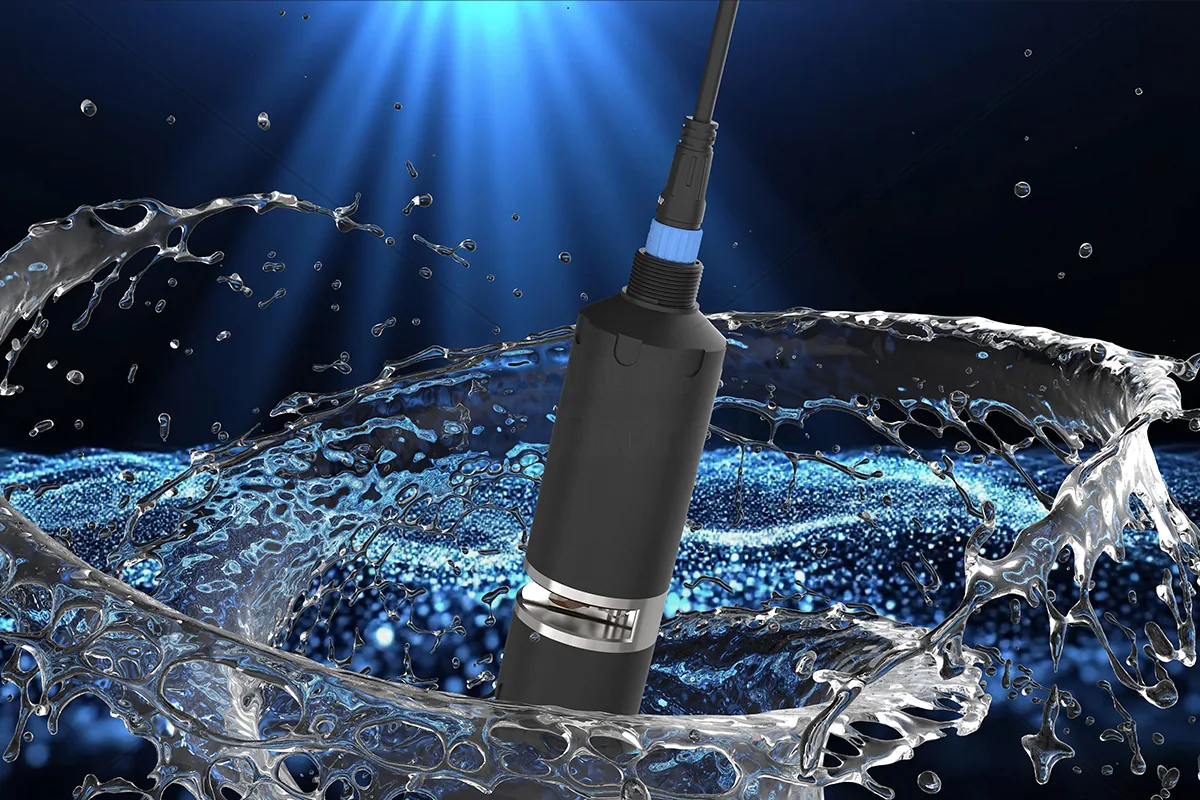
The non-contact spectral measurement design of the NSDD6 keeps the optical path out of direct contact with the measured water sample, structurally slowing fouling. At the same time, the product features automatic physical cleaning, further suppressing fouling accumulation during long-term operation. Its housing uses 316L stainless steel and POM industrial materials, balancing corrosion resistance and mechanical strength, and is suitable for scenarios such as surface water, industrial and domestic wastewater, treatment plant effluent and outfall monitoring.
In engineering deployment, the combination of non-contact operation and automatic cleaning means:
- Longer cleaning intervals and less manual intervention;
- Higher data continuity, making it better suited for influent/effluent comparison and anomaly early warning in wastewater treatment;
- However, for water with high suspended solids concentrations or strong scaling tendencies, the cleaning strategy still needs to be evaluated according to site conditions.
Fouling control is not a claim of maintenance-free operation, but a design approach that extends effective operating time and reduces maintenance frequency.
Maintenance Design and Adaptability to Industrial Environments
Beyond the measurement principle, the ease of installation, communication and maintenance of an industrial sensor directly affects project life-cycle costs. The NSDD6 supports long-distance isolated RS485 communication, suitable for the multi-point wiring common in industrial sites, reducing the effects of electromagnetic interference and ground loops. Its 316L stainless steel and POM construction can adapt to wastewater treatment and industrial process water environments, but corrosivity, temperature and installation location at different sites still need to be assessed individually.
The engineering value of the maintenance design is reflected in:
- No need to frequently disassemble the entire unit when replacing, cleaning or calibrating the sensor;
- Standard communication interfaces for easy integration with existing PLC, RTU or SCADA systems;
- Relatively low costs for on-site spare parts and operator training.
It must be emphasized that no sensor can be completely maintenance-free. Engineering teams should establish cleaning plans based on the actual fouling level of the water sample and record data changes before and after maintenance to determine whether the cleaning interval is reasonable.
COD Sensor Selection and Validation: From Trend Monitoring to Trustworthy Data
When selecting a sensor, do not rely only on the label that it can measure COD; evaluate it in light of on-site water quality, installation conditions and data use. The following table provides a practical decision framework:
| Evaluation Dimension | On-Site Validation Points | Engineering Decision Guidance |
|---|---|---|
| Water Sample Matrix | Color, turbidity, chloride, suspended solids | High-interference water samples require more comparison points |
| Measurement Parameters | COD, TOC, UV254, turbidity, color, temperature | Select parameter combinations according to process needs and avoid redundancy |
| Installation Environment | Flow velocity, bubbles, wall adhesion, temperature fluctuations | Prefer locations with stable flow conditions and easy maintenance |
| Data Quality | Deviation from laboratory methods | Establish a local calibration model and review it periodically |
| Maintenance Cost | Cleaning frequency, consumables, labor | Reagent-free operation and automatic cleaning can lower long-term OPEX |
Recommended implementation steps:
- Site survey and sampling: Understand the range of water quality fluctuations and collect representative water samples for laboratory analysis.
- Sensor installation and baseline monitoring: Fix the sensor according to installation location recommendations and continuously record raw signals for several days.
- Laboratory comparison and modeling: Send synchronously collected field water samples to the laboratory, measure COD/TOC and other parameters using standard methods, and establish a regression or correction relationship between optical signals and laboratory values.
- Model validation and adjustment: Validate the model with another independent set of water samples, and introduce auxiliary parameters such as turbidity and color to correct interference when necessary.
- Long-term data tracking: Conduct periodic laboratory comparisons to track model drift; when water quality characteristics change significantly (e.g., changes in influent source or seasonal variation), revalidation is required.
Limitations also need to be made clear: optical COD/TOC/UV254 measurement is a surrogate measurement, and its accuracy depends heavily on the water sample matrix. For industrial wastewater with complex composition and drastic changes, a single model may not cover all operating conditions. Therefore, sensors such as the NSDD6 are better suited as early-warning and trend-monitoring tools; if used for discharge compliance or process assessment, laboratory standard methods must be the final basis, and local regulations must be followed.
FAQ
Q: Can the NSDD6 COD sensor be used directly for discharge compliance reporting?
A: Not recommended. The NSDD6 is a field optical sensor intended for continuous trend monitoring and process control. Compliance reporting usually requires standard laboratory methods (such as dichromate COD) and a reliable relationship between the field sensor and the laboratory method established through validation with actual water samples. Online data not recognized by the local environmental authority cannot be used directly as an enforcement basis.
Q: Does a reagent-free optical sensor require no calibration at all?
A: No. Reagent-free only means that no chemical reagents are needed, but laboratory comparison and model calibration with actual water samples are still required. The general model provided before the sensor leaves the factory can only serve as an initial reference; the absorption spectral characteristics of different water qualities differ, and reliable data can only be obtained through on-site validation.
In summary, through non-contact spectral measurement and automatic cleaning design, the NSDD6 provides an engineered hardware foundation for multiparameter online monitoring of COD, TOC, UV254 and other parameters without chemical reagents. The engineering value is ultimately reflected in lower operating costs, higher data continuity and simplified maintenance processes. But the prerequisite for project success always remains: validate the sensor's measurement model with actual water samples and clearly define its boundaries as a trend-monitoring tool.
Discuss your application
Tell us your target parameters, water matrix, interface and annual volume. Our engineering team will recommend a practical configuration.
Request a Quote