
# What Water Sample and Process Information Should Be Collected Before Selecting the NSDD6 Water Quality Sensor?
Industrial water quality sensor selection failures are often not caused by insufficient sensor performance, but by incomplete understanding of the water sample and process conditions beforehand. The NSDD6 is a self-cleaning, reagent-free multiparameter water quality sensor that simultaneously outputs TOC, COD, turbidity, color, UV254 and temperature signals, and is suitable for continuous trend monitoring of surface water, industrial and domestic wastewater, treatment plant effluent and discharge points. Before purchasing, however, engineers and integrators must systematically answer the following questions to avoid range mismatch, optical window fouling and communication interruptions. The project discovery checklist below can be used directly for site surveys and technical discussions.
Why Information Collection Before Water Quality Sensor Selection Determines Success
The NSDD6 uses non-contact spectral measurement, requires no chemical reagents and features automatic physical cleaning, making it suitable for long-term field deployment. However, spectral methods are sensitive to the water sample matrix: aromatic compounds, color and turbidity in different industrial wastewaters alter the UV-Vis absorption characteristics and directly affect the signal conversion of parameters such as COD/TOC. Without clarifying the matrix type and concentration range before selection, it is impossible to determine whether the sensor model is suitable or to plan laboratory comparison frequency. Likewise, suspended solids characteristics, pressure, temperature, flow regime and installation space determine whether the sensor can operate stably, while communications and service responsibilities determine whether data can truly enter the control system and remain valid over time. Information collection is therefore not optional; it is the first step in selection.
Project Discovery Checklist: 10 Items of Information That Must Be Collected
The checklist below covers the key dimensions to confirm before selecting the NSDD6. It is recommended to fill in each item to form an attachment to the technical specification.
| Category | Questions to Clarify | Impact on NSDD6 Selection |
|---|---|---|
| Water Sample Matrix | Is it surface water, domestic wastewater, industrial wastewater or treated effluent? What are the main components/industries? | Determines spectral interference and scaling tendency, and informs the cleaning strategy and calibration model. |
| Target Decision | Is it for trend warning, process optimization, discharge screening or compliance monitoring? | Determines signal correlation and calibration depth; compliance must be supported by laboratory methods. |
| Measurement Range | What are the expected minimum and maximum values of COD, TOC, turbidity, color and UV254? | Select the appropriate range/model to avoid over-range or insufficient low-end resolution. |
| Suspended Solids | Suspended solids concentration, particle size, stickiness, oil or fiber content? | Assess optical window fouling risk and confirm whether automatic physical cleaning capability is sufficient. |
| Pressure | Maximum working pressure and transient water hammer in the pipe/pool? | Sensor structural strength and sealing rating must match; refer to the specification sheet for details. |
| Temperature | Medium temperature range and ambient temperature? | Temperature compensation and electronic component tolerance must be confirmed. |
| Flow Regime | Flow velocity, full pipe or not, bubbles present, intermittent flow? | Sampling representativeness; bubbles adhering to the optical window can affect spectral measurement. |
| Installation Space | Pool/pipe dimensions, available mounting port, maintenance access? | Selection of immersion or flow-through adapter, and maintenance accessibility. |
| Communications | Does the existing control system support RS485/Modbus? Wiring distance? | The NSDD6 uses isolated RS485; protocol, termination resistor and power supply must be confirmed. |
| Service Responsibilities | Who is responsible for periodic calibration verification, cleaning maintenance and data review? | Automatic physical cleaning reduces manual frequency, but spectral correlations still require periodic verification. |
How to Determine the Water Sample Matrix and Target Decision
The water sample matrix is the primary variable for spectral water quality sensors. If the site is municipal wastewater with a stable composition, a linear correlation between the UV254 or TOC signal and laboratory COD is usually sufficient for trend warning. Industrial wastewater, however, may contain high concentrations of aromatic compounds, dyes or metal complexes that absorb strongly in the UV region, potentially causing the COD signal to read high or low. In this case, representative water samples must be sent to a laboratory to obtain COD, TOC, turbidity and color baselines and to perform multi-point comparison with the sensor signal. The NSDD6's multiparameter output helps identify interference: for example, rising turbidity with unchanged UV254 may reflect only a change in suspended solids rather than a change in organic load.
The target decision determines whether the sensor serves as a process optimization tool or as auxiliary discharge monitoring. For process control, response speed and trend consistency matter more; for discharge screening, a site-specific model must be established and periodically verified with standard laboratory methods. Never equate an online spectral sensor directly with a compliance analyzer.
Suspended Solids, Pressure, Temperature and Flow Regime: Site Boundaries
Suspended solids are a key factor affecting the long-term stability of the NSDD6. Although the sensor has automatic physical cleaning, high-concentration, sticky or fibrous suspended solids may still cause optical window fouling. Before selection, understand the suspended solids concentration range, particle size distribution and whether oil is present. If necessary, conduct a short-term coupon test on site to observe the actual effect of the cleaning mechanism.
Pressure, temperature and flow regime are environmental boundaries. The NSDD6 uses 316L stainless steel and POM industrial construction, but the specific pressure and temperature ratings should be based on the manufacturer's technical specification sheet and must not be assumed as generic values. The installation point should avoid dead zones, strong vortices and bubble accumulation areas; if the pipe is not full or flow is intermittent, choose an appropriate installation method or add a sampling bypass. Temperature affects not only electronic components but also the spectral characteristics of the water sample, so the temperature variation range must be clarified for compensation.
Installation Space and Communications Planning
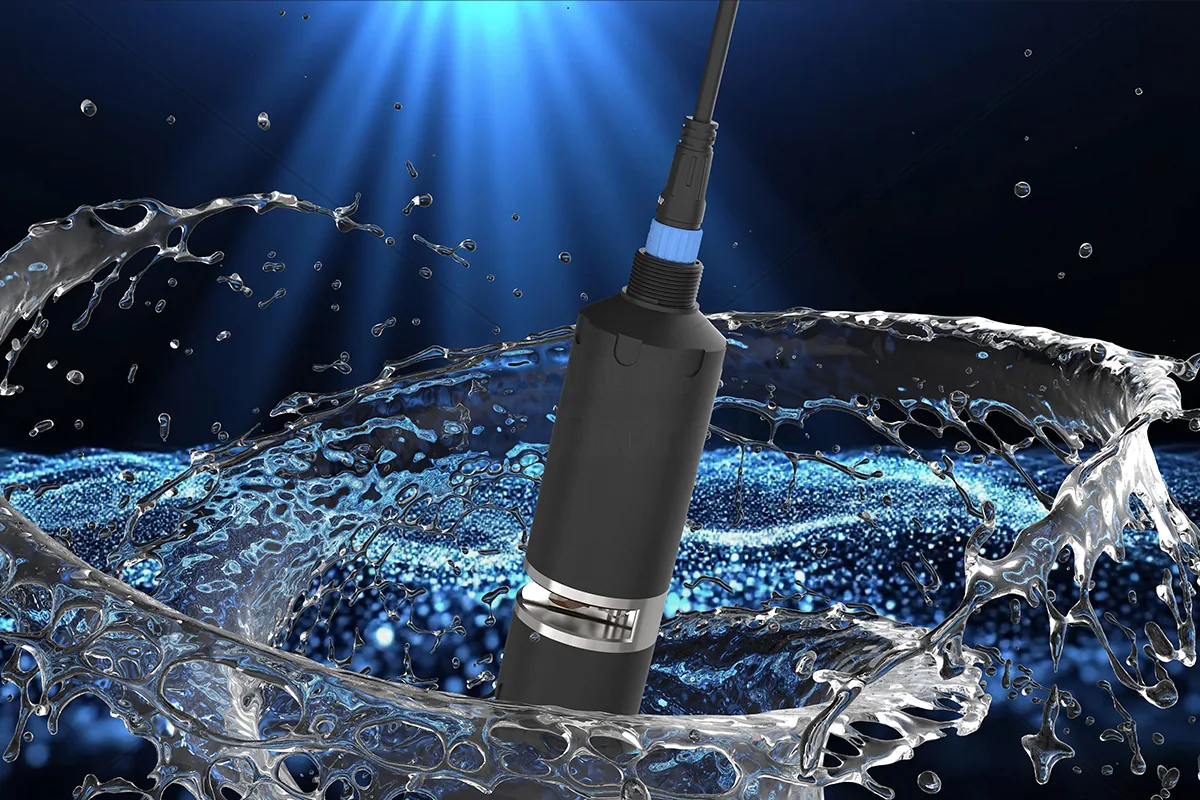
The NSDD6 supports immersion installation; the specific adapter must be selected according to pool or pipe dimensions. Measure the available mounting port diameter, insertion depth and maintenance space on site to ensure the sensor can be removed for maintenance. For closed pipes, confirm whether a flow-through cell or ball valve insertion assembly can be installed.
For communications, the NSDD6 provides a long-distance isolated RS485 interface suitable for connection to a PLC or RTU. During selection, confirm whether the host system supports the Modbus protocol, whether the fieldbus length exceeds the RS485 specification (usually related to baud rate; refer to the standard), whether termination resistors are needed, and whether the supply voltage is stable. For multi-sensor networks, also plan address assignment and polling cycles.
Service Responsibilities and Verification Methods
Online water quality sensors require clear service responsibilities, otherwise data quality will degrade over time. A designated person should be responsible for periodically checking optical window cleanliness, checking signal drift and performing calibration verification. The NSDD6's automatic physical cleaning reduces the frequency of manual cleaning but cannot eliminate maintenance entirely.
Verification methods are central to ensuring data credibility. Recommended steps:
- Before installation, collect at least 5–8 water samples covering the expected concentration range and send them to a laboratory for COD, TOC, turbidity and other analyses.
- After installation, compare on-site online readings with laboratory results to establish a local calibration curve.
- Perform a laboratory comparison weekly during initial operation, then review monthly or quarterly once stable.
- Record sensor signals, laboratory data and maintenance actions to form a traceable data quality record.
It should be emphasized that the NSDD6 is an online trend monitoring and screening tool, not a laboratory replacement. Discharge compliance data must use standard laboratory methods; sensor data can be used for early warning and process adjustment.
Limitations
- Spectral methods may show deviations for certain special matrices (such as high-color or strongly fluorescent wastewater), which require correction through local calibration.
- Automatic physical cleaning cannot address all fouling scenarios; extreme suspended solids conditions require additional pretreatment or more frequent maintenance.
- Sensor output is a converted optical signal value; different sites require different correlation models, and parameters from other sites cannot be applied directly.
- Actual measurement accuracy, range, pressure and temperature ratings and other parameters are subject to the manufacturer's published technical specification sheet; this article does not provide unverified values.
FAQ
Q: Can the NSDD6 water quality sensor be used directly for environmental acceptance or discharge reporting? A: No. The NSDD6 provides continuous trend monitoring signals and is an online screening tool. Environmental acceptance and discharge reporting must be based on standard laboratory methods (such as the COD dichromate method and the TOC combustion method). NSDD6 data can be used for process early warning and to reduce laboratory sampling frequency.
Q: What information is most easily overlooked before selection? A: Suspended solids characteristics and flow regime. Highly sticky suspended solids or intermittent flow can easily cause optical window fouling and unrepresentative sampling. It is recommended to actually collect water samples for observation and confirm the flow velocity and bubble conditions at the installation point.
Q: What should be noted when extending the communication distance? A: RS485 bus distance is related to baud rate, cable quality and termination matching. Follow standard recommendations and, if necessary, add a repeater or use shielded twisted pair cable. The NSDD6 uses isolated RS485, but voltage drop and signal integrity still need to be calculated for long distances.
Q: Does automatic physical cleaning mean maintenance-free? A: No. Automatic cleaning can significantly reduce the frequency of manual cleaning, but the sensor still requires periodic optical window inspection, signal drift verification and model calibration. The maintenance interval should be determined according to on-site water quality.
Discuss your application
Tell us your target parameters, water matrix, interface and annual volume. Our engineering team will recommend a practical configuration.
Request a Quote