
In online water quality monitoring, optical/spectral metrics such as COD, TOC, and UV254 are often used as the core pollution load parameters. However, if you focus only on these metrics and ignore temperature, maintenance flags, and timestamps, it is easy to misread normal temperature-induced fluctuations as process anomalies or discharge events. Using the NSDD6 industrial multispectral water quality sensor from Orome Electrical as an example, this article explains how the temperature signal helps engineers and water quality managers interpret online data more reliably, and provides implementation steps, limitations, and verification methods.
Why temperature is not an "auxiliary parameter"
Temperature directly or indirectly affects the water sample and the sensor:
- Affects chemical reaction rates: Rising temperature generally accelerates the oxidation rate of organic matter, which may change laboratory COD/TOC results and also affects the rate of biodegradation in the water body.
- Affects spectral measurement: UV-Vis spectral response may change with temperature, especially the absorption characteristics of the sample, the conformation of dissolved organic matter, and particle scattering.
- Affects the stability of the sensor electronics and light source, causing drift.
- Affects the fouling rate: Rising temperature may promote biofilm growth and increase contamination of the optical window.
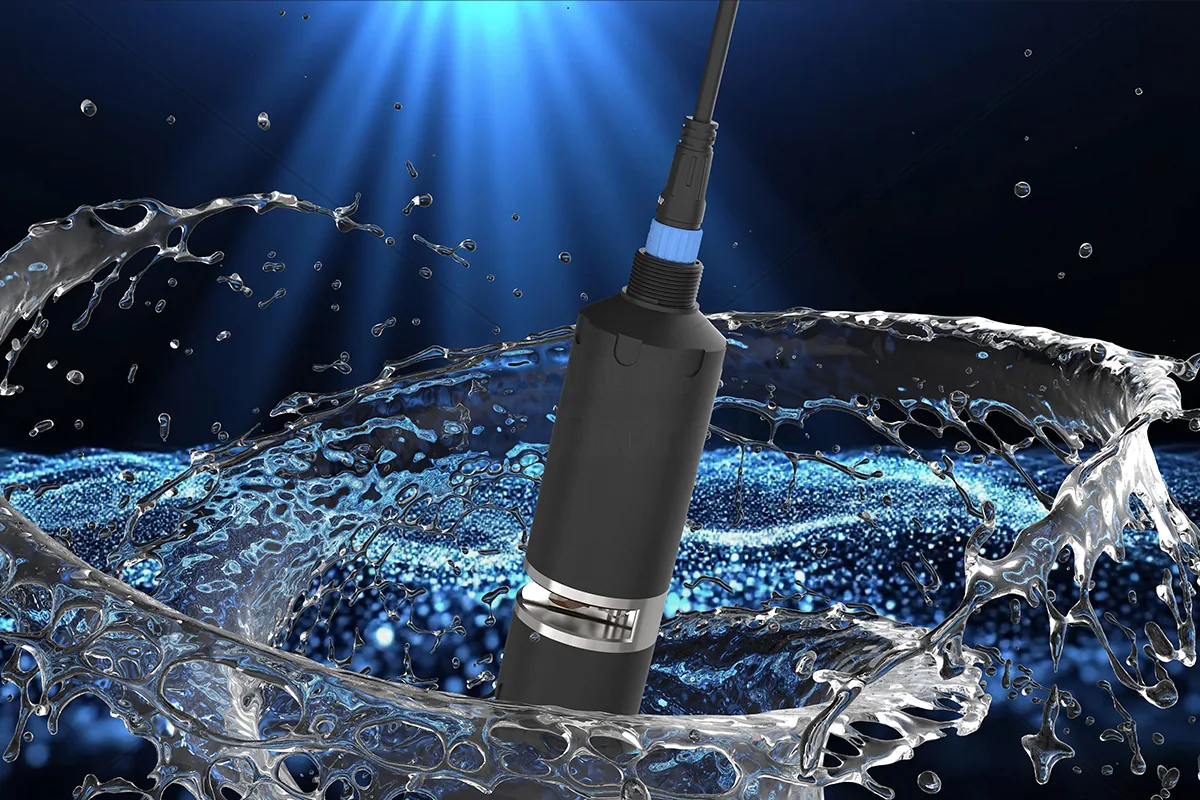
The NSDD6 outputs temperature as one of six metrics (TOC, COD, turbidity, color, UV254, temperature), showing that temperature is not a dispensable "auxiliary parameter" but important context for interpreting the other metrics.
Three types of information that must be retained on the dashboard: temperature, maintenance, time
Effective trend interpretation must be based on the raw context. It is recommended to retain at least the following on the dashboard:
- An unsmoothed temperature curve, along with the diurnal and seasonal variation of water temperature.
- Automatic cleaning/maintenance flags: The NSDD6 has an automatic physical cleaning function, and cleaning actions may cause transient signal fluctuations, so the cleaning windows need to be flagged.
- Timestamps: Ensure that temperature and COD/TOC/UV254 data points are aligned to avoid time misalignment.
Do not retain only the filtered trend line, otherwise key events such as cleaning, rainfall, and sudden temperature changes will be lost.
The following is a qualitative cross-reference table to help field engineers make quick judgments:
| Observed phenomenon | Possible explanation | Recommended action |
|---|---|---|
| COD/TOC rises while temperature also rises | Summer runoff, increased biological activity, organic matter carried by rainfall | Combine with rainfall/flow data and observe whether it returns to normal |
| COD/TOC rises while temperature stays unchanged or falls | A discharge or abnormal influent may exist | Check upstream discharges, compare with laboratory sampling |
| Turbidity rises while temperature drops sharply | Rainfall mixing, pond turnover, sediment resuspension | Observe the trend and confirm whether it is accompanied by a conductivity change |
| Metrics fluctuate or drop transiently after cleaning | Automatic cleaning has removed window fouling | Flag the cleaning window and exclude it from trend statistics |
Note: This table reflects general engineering experience and does not constitute a guarantee of the specific behavior of the NSDD6; it should be verified against on-site conditions.
Engineering decision method: how to use temperature to support water quality interpretation
Step 1: Clarify the monitoring objective and temperature background Before installing the NSDD6, record the baseline temperature range, seasonal variation, and diurnal variation amplitude of the monitoring point. If the monitoring point is affected by industrial cooling water or thermal discharge, the temperature signal may be used to identify mixing events.
Step 2: Establish joint multi-parameter observation Place temperature and COD/TOC/UV254 on the same time axis, and do not set thresholds in isolation. For example, trigger an anomaly alarm only when COD exceeds the threshold and temperature shows no corresponding change; if temperature rises simultaneously, it may be a natural change.
Step 3: Distinguish between "normal instrument response" and "real changes in the water sample" Temperature changes may cause sensor baseline drift. Without a vendor-verified compensation model, it is not recommended to use temperature to directly correct COD/TOC readings. Instead, treat temperature as an explanatory variable and use laboratory comparison to determine whether a systematic deviation exists.
Step 4: Record maintenance and cleaning events The self-cleaning function of the NSDD6 reduces manual maintenance, but cleaning cycles and cleaning actions may affect short-term data. It is recommended to record "automatic cleaning start/end" or "manual maintenance" events in the data platform, and data within the relevant windows should be handled specially in trend statistics.
Step 5: Set reasonable temperature and rate-of-change alarms For example, when the water temperature changes by more than a certain amount within 1 hour (the specific threshold is determined on site), trigger a "temperature abrupt change" notice to remind operators to check whether other parameters change simultaneously. Do not rely solely on absolute-value alarms for a single parameter.
Applicable boundaries and limitations
- The NSDD6 is a sensor for continuous trend monitoring and screening, and does not replace laboratory standard methods. For compliance discharge or dispute evidence collection, sampling and analysis according to standard methods are still required.
- The role of the temperature signal is to support interpretation, not automatic compensation. Orome Electrical's public materials do not state that the NSDD6 has a built-in specific temperature compensation model or compensation coefficients, so it cannot be assumed that temperature can accurately correct other metrics.
- The relationship between COD/TOC and spectral response in different water bodies is strongly affected by the matrix, and temperature effects may also vary by matrix. On-site comparison is necessary.
- There may be slight spatial differences between the sensor's temperature measurement point and optical measurement point, and response times may also differ, causing time misalignment between temperature and other parameters during rapid changes.
- Although automatic physical cleaning can control fouling, manual inspection of the window and calibration are still required after extreme contamination or long-term operation.
Verification Methods
Establish a local verification process:
- Baseline comparison: Under stable operating conditions, take laboratory water samples weekly or monthly, simultaneously record the NSDD6's COD/TOC/UV254 and temperature, calculate the deviation, and observe whether the deviation changes systematically with temperature.
- Natural temperature experiment: Use diurnal or seasonal temperature changes to observe the fluctuation range of sensor readings without manual intervention, and confirm which fluctuations are related to temperature.
- Verification before and after cleaning: Record data before and after automatic cleaning, evaluate the effect of cleaning on readings, and set a data flagging period.
- Anomaly event review: When a COD/TOC anomaly occurs, review temperature, maintenance flags, and timestamps to determine whether it is a real event or a measurement artifact.
- Standard substance check: If on-site conditions permit, use standard solutions of known concentration or blank water samples to check sensor response while recording temperature. Note that the temperature of the standard solution should be close to that on site.
FAQ
Q: Can the NSDD6 temperature signal directly compensate COD readings? A: Based on the available product information, the NSDD6 does not state a built-in automatic temperature compensation model. Temperature is mainly used to support data interpretation and trend judgment; it is not recommended to use temperature to directly correct COD/TOC readings. A local correction strategy should be established based on on-site laboratory comparison.
Q: What is the difference between an online COD sensor and laboratory COD? A: Online spectral COD sensors provide continuous, real-time trend information and are suitable for screening and early warning; laboratory COD is a discrete measurement by a standard method and is usually the basis for compliance. The correlation between the two needs on-site verification and may be affected by temperature, turbidity, color, and other factors.
Q: How can normal temperature-induced fluctuations be prevented from being misjudged as pollution events? A: Establish a temperature baseline and observe diurnal and seasonal patterns; retain temperature, maintenance flags, and timestamps in the monitoring platform; when COD/TOC/UV254 changes are consistent with temperature changes in time and direction, check natural causes first before considering human discharges.
Q: What application scenarios is the NSDD6 suitable for? A: According to Orome Electrical's information, the NSDD6 is suitable for surface water, industrial and domestic wastewater, treatment plant effluent and discharge monitoring, and can also be used for aquaculture and continuous water quality tracking in industrial process water.
Q: When selecting a multiparameter water quality sensor, why is the temperature metric important? A: Temperature not only affects the chemical state of the water sample and the sensor response, but also helps distinguish natural changes from anomalous events. Choosing a multiparameter water quality sensor with temperature output provides the necessary environmental context without adding extra equipment.
Discuss your application
Tell us your target parameters, water matrix, interface and annual volume. Our engineering team will recommend a practical configuration.
Request a Quote