
Why process screening needs a COD sensor and TOC/UV254 signals
In wastewater treatment and industrial process water management, rapid changes in organic load often appear before an incident does. Laboratory COD/TOC analysis is accurate, but its long sampling cycle and high reagent consumption make it unsuitable for real-time process adjustments. The NSDD6 multiparameter water quality sensor uses non-contact spectral measurement to output TOC, COD, UV254, turbidity, color and temperature simultaneously, providing high-frequency screening data on site. The core value of this kind of online signal is not to replace laboratory reports, but to serve as a leading observation point for "process screening": detecting abnormal trends, triggering manual sampling, and shortening response time.
For engineers, a COD sensor provides a continuous observation window. It helps teams react quickly to influent shocks, process anomalies or effluent fluctuations, rather than missing the best moment for adjustment while waiting for laboratory results. This shift from periodic grab sampling to continuous trend monitoring is the foundation of refined operation in modern water treatment systems.
Measurement capability and cleaning design of the NSDD6
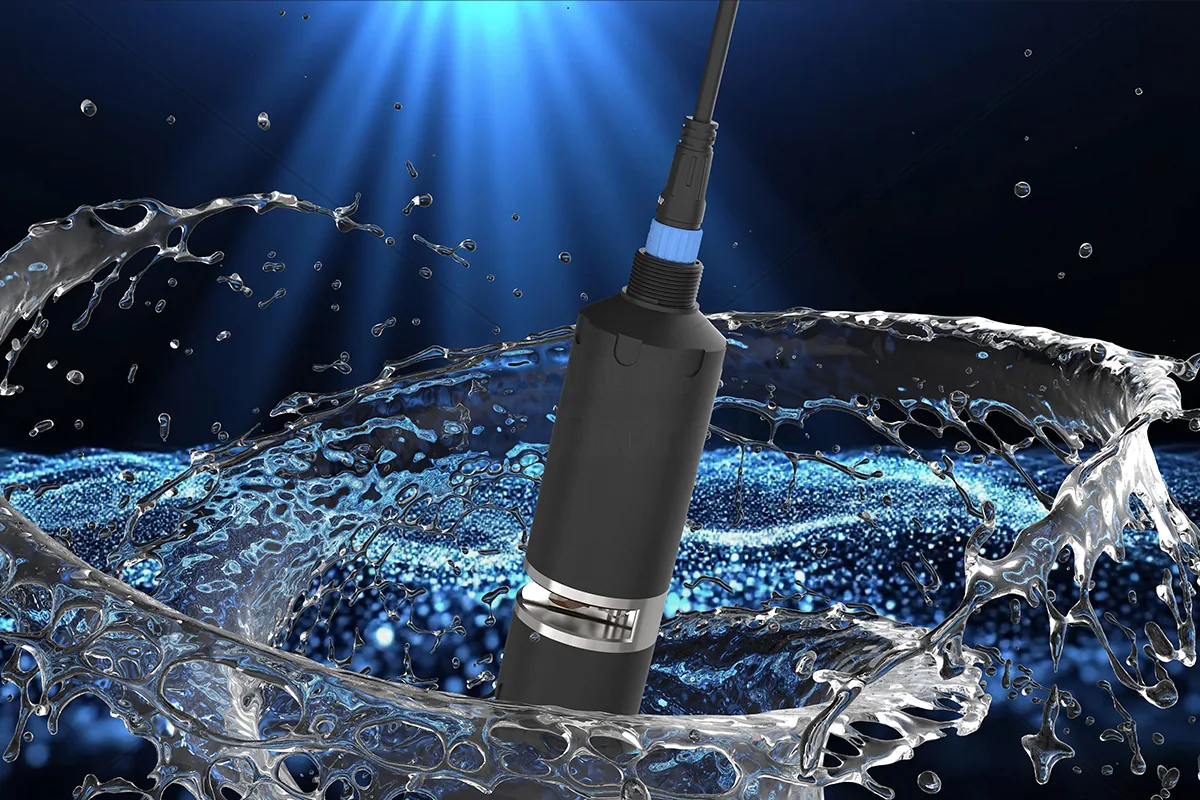
The NSDD6 is a multiparameter water quality sensor. Its main features include:
- Up to six parameters: TOC, COD, turbidity, color, UV254 and temperature;
- Reagent-free, non-contact spectral measurement that reduces consumables and maintenance;
- Automatic physical cleaning to control biofilm and particle adhesion;
- Long-distance isolated RS485 communication for easy integration into existing monitoring systems;
- 316L stainless steel and POM construction for industrial site environments.
For process screening, TOC and COD are two complementary ways of expressing organic matter. TOC directly reflects total organic carbon, while COD represents chemical oxygen demand. The two are usually correlated in a stable matrix, but it is important to note that their physical meaning and applicable conditions differ. The multiparameter output of the NSDD6 lets users verify anomalies from multiple dimensions rather than relying on a single indicator.
Differences between TOC, COD and UV254 and how to interpret them in engineering
In actual engineering, a single parameter is often insufficient to judge the nature of contamination. The NSDD6 also provides a UV254 signal, which can help distinguish types of organic matter.
| Signal | Engineering significance | How to use it in process screening |
|---|---|---|
| TOC | Total organic carbon, directly related to the total amount of organic matter | Judge the trend of organic load changes in influent/effluent |
| COD | Chemical oxygen demand, related to the oxygen consumption risk of the receiving water body | Quickly identify shocks of oxidizable pollutants |
| UV254 | UV absorbance, sensitive to aromatic and unsaturated organic matter | Help judge changes in organic composition and disinfection by-product precursors |
Note that the TOC and COD output by the NSDD6 are screening values calculated from spectral models, not results of standard laboratory methods. Their accuracy is affected by the sample matrix and should be compared with laboratory data regularly. In practice, the spectral method builds a multivariate model from absorption features in specific bands, correlating UV-visible absorption spectra with laboratory TOC/COD values. As long as the matrix remains relatively stable, the model can provide trend data with reference value.
Matrix correlation: the key to successful process screening
The organic composition of different water samples varies considerably. For example, industrial wastewater may contain large amounts of refractory organics, while domestic sewage is dominated by readily degradable organics. The spectral method builds a model from absorption features in specific bands, but the model is sensitive to matrix changes: color, turbidity, chloride ions, particles and others can all interfere with the signal. Therefore, after on-site deployment, at least one set of parallel sampling should be carried out to establish a local correlation coefficient or correction model. When process raw materials, seasons or influent characteristics change significantly, the correlation needs to be re-evaluated.
Engineers need to understand that the same COD sensor may perform differently at different points. A model that works well at a municipal wastewater plant may be completely unsuitable if transferred directly to chemical park wastewater. Therefore, on-site investigation and localized calibration before selection and deployment are steps that cannot be skipped. The NSDD6 itself does not have the ability to automatically adapt to all matrices, but its multiparameter output and automatic cleaning provide a better foundation for stable long-term operation.
Confirmation and closed-loop workflow after an alarm
The value of online monitoring lies in enabling tiered response. When the TOC or COD signal exceeds a preset threshold or shows an abnormal slope, the following steps are recommended:
- Confirm sensor status: check whether automatic cleaning is working properly, whether the optical window is contaminated, and whether the data is stable;
- Observe auxiliary parameters: use changes in turbidity, color and temperature to judge whether it is a real contamination event;
- Immediately collect a representative sample and perform laboratory TOC/COD analysis according to standard methods;
- Compare laboratory results with the online signal; if the deviation exceeds the acceptable range, adjust the model or threshold;
- Record the whole event for subsequent process optimization and model maintenance.
Clearly, laboratory analysis bears the final confirmation and compliance responsibility in this closed loop, while the NSDD6 is responsible for continuous initial screening and trend warning. This division of responsibility—"online screening, laboratory confirmation"—avoids over-reliance on field sensors while making full use of the real-time value of high-frequency data.
Implementation steps and model validation
For wastewater treatment plants or industrial users, the following engineering steps are recommended when introducing the NSDD6:
- Determine monitoring points: prioritize influent, effluent or key process nodes;
- Installation and communication commissioning: use the RS485 interface to connect to a PLC or SCADA;
- Baseline data collection: run continuously for at least several days and record the fluctuation range of each parameter;
- Parallel sampling comparison: take several samples during different load periods for laboratory analysis;
- Establish a screening model or correction coefficient for that point;
- Set alarm thresholds and hysteresis to avoid frequent false alarms;
- Regular verification: carry out spot-check comparisons monthly or quarterly to verify model stability.
Verification is not only about single-point comparison; trend consistency deserves even more attention. The correlation coefficient between online signals and laboratory series, the mean relative error, and alarm consistency are all important indicators for evaluating a screening model. If trend consistency declines, attention should be paid even if the absolute error is small, because this indicates that the matrix is changing.
Engineering selection and decision points
When evaluating online water quality monitoring equipment for process screening, consider the following dimensions:
- Measurement principle: whether it is non-contact and reagent-free, and whether it can reduce maintenance frequency;
- Cleaning mechanism: whether automatic physical cleaning is effective and can adapt to the scaling characteristics of the target water body;
- Multiparameter capability: whether it can output auxiliary parameters for cross-validation and interference identification;
- Communication compatibility: support for standard industrial protocols (such as RS485) for easy system integration;
- Material and protection: whether it is suitable for long-term immersion in industrial or municipal environments;
- Local calibration support: whether the manufacturer can provide on-site comparison and model commissioning services.
The NSDD6 offers a clear engineering configuration in these respects: 316L stainless steel and POM housing, automatic cleaning, multispectral measurement and RS485 output. However, the final selection still requires testing based on actual water quality, installation conditions and budget.
Limitations and division of responsibility with the laboratory
It must be clear: the TOC and COD signals of the NSDD6 are for process screening and trend monitoring, and should not be used for the final determination of regulatory compliance reports. When the water matrix is unstable, strong interfering substances are present, or precise compliance data is required, standard laboratory methods should prevail. In addition, although the sensor has automatic cleaning, extreme scaling or oily environments may still affect measurement and should be combined with an on-site maintenance plan.
Online monitoring and laboratory analysis are not competitors but complements. The former provides frequency and speed, while the latter provides accuracy and legal validity. A reasonable engineering strategy is to use online signals to drive daily operations and warnings, and use laboratory data for regular calibration and compliance confirmation.
FAQ
Q: Can the COD signal from the NSDD6 be used directly as discharge report data?
A: No. The COD signal from the NSDD6 is a screening value based on a spectral model and can be used for trend warning and process control, but regulatory reports must use standard laboratory methods. It is recommended to compare online signals with laboratory results regularly to ensure the screening model remains valid.
Q: How can I tell whether the TOC and COD signals are reliable?
A: In addition to observing signal stability, regularly collect parallel samples for laboratory analysis and compare the trends and correlation coefficients of the two. If a significant deviation occurs, check the optical window, cleaning effectiveness and whether the influent matrix has changed.
Q: What additional help does the UV254 signal provide?
A: UV254 is sensitive to specific organic matter and is often used to judge changes in organic type or disinfection by-product precursors. When TOC/COD changes little but UV254 fluctuates noticeably, it may indicate that the organic composition has changed.
Discuss your application
Tell us your target parameters, water matrix, interface and annual volume. Our engineering team will recommend a practical configuration.
Request a Quote