
Introduction
In online water quality monitoring, many users choose UV-Vis spectral COD sensors or UV254 sensors to obtain continuous organic load trends. These sensors do not directly measure dichromate COD; instead, they capture the absorption/scattering characteristics of the water sample at multiple wavelengths and convert them through a site-established "spectral signal—laboratory COD" correlation model. This model is valid only under a specific water sample matrix. Once the incoming water source, season, process chemicals or production batch changes, the interfering substances, particle distribution or dissolved organic matter composition in the water sample change, and the original correlation model may drift. Therefore, on-site continuous monitoring systems must treat "re-validation" as a routine quality control action, not a one-time calibration for lifelong use.
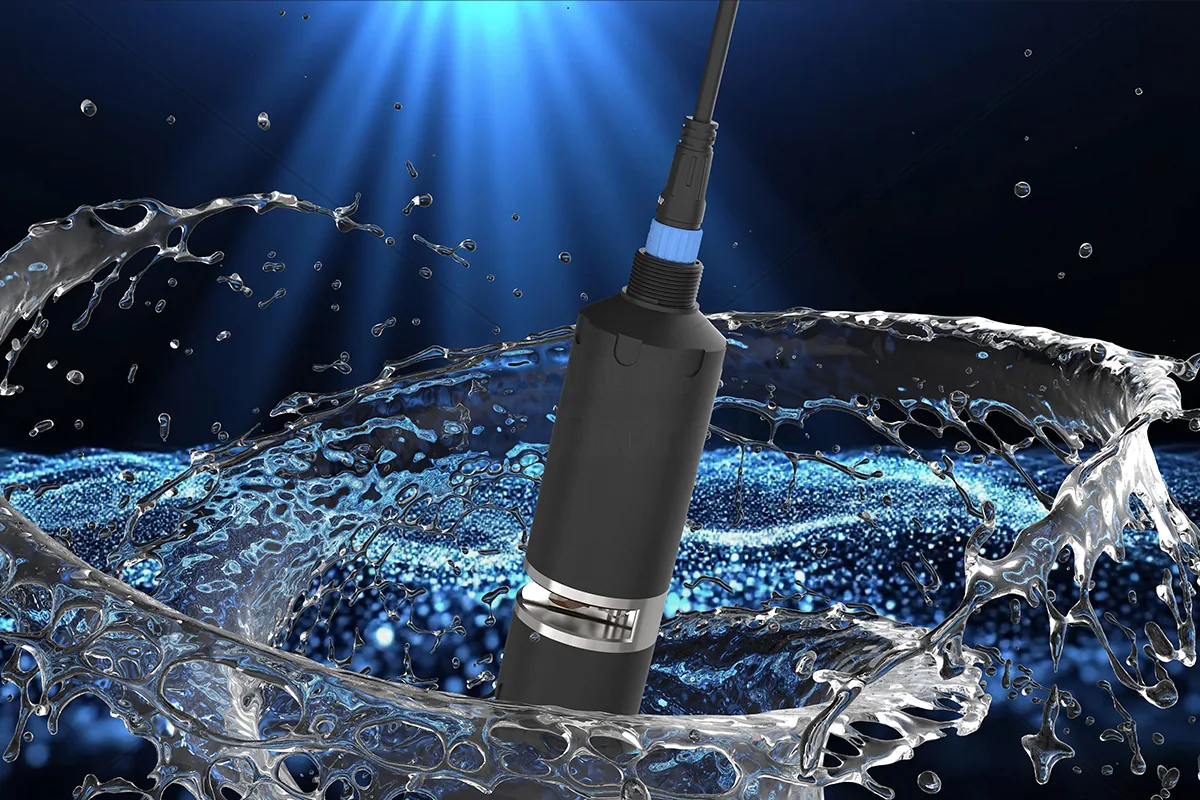
The NSDD6 industrial multispectral water quality sensor supports non-contact spectral measurement without reagents and can simultaneously output six parameters: COD, TOC, UV254, turbidity, color and temperature. Even with multispectral technology, the impact of water sample matrix changes on the correlation model cannot be ignored. This article is intended for engineers, system integrators and technical procurement personnel, and discusses the trigger conditions for matrix changes, re-validation methods and the applicable boundaries of NSDD6.
Why Spectral COD Sensors Depend on the On-Site Matrix
UV254 sensors indirectly reflect organic content by measuring the UV absorbance of the water sample near 254 nm, but different types of organic matter have different response coefficients to UV absorption; suspended particles, color, inorganic ions and bubbles also produce scattering or absorption. COD sensors (such as the COD channel of NSDD6) are typically based on multi-wavelength spectra and on-site calibration models, converting spectral features into "equivalent COD" values comparable to the laboratory dichromate method.
This conversion model is essentially a statistical correlation, not a stoichiometric relationship. For example, the same UV254 absorbance may correspond to very different laboratory COD values in domestic sewage, printing and dyeing wastewater or food processing wastewater. Therefore, a model established under a certain water source or process condition can only be used within the range where that matrix is relatively stable. Once the matrix changes, the model slope, intercept or nonlinear characteristics may change, causing sensor readings to be systematically high or low.
Four Typical Triggers of Water Sample Matrix Changes
The following four types of changes are most common in on-site operation.
| Type of Change | Typical Manifestation | Main Impact on Spectral Correlation | Recommended action |
|---|---|---|---|
| Change in incoming water source | New water source connected, combined rain/sewage flow, upstream enterprise discharge switching | Changes in the type and concentration distribution of dissolved organic matter, UV254/COD slope changes | Collect paired samples and evaluate the deviation |
| Seasonal change | Water temperature changes, algal blooms, increased runoff in rainy season | Particle and color interference increases, turbidity compensation may fail | Re-validate at least once per quarter |
| Change in process chemicals | Replacement of flocculants, disinfectants, pH adjusters or phosphorus removal agents | The chemicals themselves produce UV absorption or change particle surface properties | Validate immediately after chemical change |
| Change in production batch | Fluctuations in organic components in industrial wastewater, product switching or cleaning cycles | Changes in characteristic pollutants cause local failure of the spectral model | Collect one sample before and after batch switching |
When to Re-Sample and Update the Baseline
It is recommended to initiate the re-validation process when any of the following occurs:
- The deviation between sensor readings and laboratory standard method results persistently exceeds the allowable range and is not caused by sensor contamination or light source degradation.
- Significant changes occur in the water source, pipe network or upstream enterprise discharge patterns.
- After seasonal transitions or extreme weather (heavy rain, prolonged drought, low temperature), water quality fluctuates significantly.
- The type or dosage of chemicals added in the wastewater treatment process is adjusted.
- After the sensor has been cleaned, light source replaced, repaired or reinstalled.
- Online monitoring data show trend changes in auxiliary parameters such as turbidity, color and temperature that cannot be explained by normal process fluctuations.
Even without obvious anomalies, it is recommended to establish a periodic validation cycle based on on-site risk. For industrial process water with large water quality fluctuations, the validation frequency should be higher than for stable surface water or municipal sewage.
The Role of NSDD6 in Multispectral Matrix Monitoring
The NSDD6 uses non-contact spectral measurement; the measurement window does not come into direct contact with the water sample, and combined with automatic physical cleaning, it can reduce the impact of biofilm and particle deposition during long-term operation. Its materials are 316L stainless steel and POM, suitable for continuous deployment scenarios such as surface water, industrial and domestic sewage, treatment plant effluent and discharge monitoring.
Multi-parameter output helps identify matrix changes. For example, when turbidity and color rise simultaneously but the COD reading does not increase in sync, it may be increased particle or color interference rather than a real increase in organic load; temperature changes affect the refractive index and spectral response of water and should also be used as auxiliary judgment. However, multi-parameter capability can only help "discover" matrix changes, not automatically correct model drift. Users still need to update the baseline through laboratory comparison.
Implementation Steps for Re-Validation
1. Confirm Trigger Conditions
Record the trigger reason, time and on-site operating conditions, and avoid performing validation while the sensor is in an abnormal state. First check sensor cleanliness, optical path status and communication stability.
2. Develop a Sampling Plan
Collect water samples synchronously near the sensor measurement point for laboratory standard method analysis. The sampling point should be as close as possible to the sensor sampling position to avoid water sample changes caused by long-distance transport. Samples should cover the actual operating low, medium and high concentration levels, and record the sensor readings, temperature, turbidity and color at the time of sampling.
3. Laboratory Analysis and Data Comparison
Measure COD (or other target parameters) of the collected water samples according to laboratory standard methods, and calculate the deviation between sensor readings and laboratory results. It is recommended to perform at least 5 valid pairs, and add parallel samples where conditions permit.
4. Update the Model or Correction Coefficients
Evaluate whether the original correlation model is still applicable based on the paired data. If the deviation is systematic, adjust model parameters or establish a new local model; if the deviation is irregular, check the source of spectral interference and, if necessary, add pretreatment or switch to multi-parameter joint correction.
5. Verify the Stability of the New Baseline
Use another batch of independent water samples to verify the new model. Maintain normal process operation during validation and observe whether sensor readings return to a reasonable range. Record the effective date, applicable conditions and validity period of the new baseline.
6. Periodic Review
Incorporate matrix changes and re-validation into the operation and maintenance ledger. After each major process adjustment, evaluate whether early validation is needed.
Limitations: The Boundary Between On-Site Screening and Laboratory Compliance
The NSDD6 provides continuous trend monitoring and anomaly warning, suitable for scenarios such as wastewater treatment process optimization, influent/effluent comparison and industrial process water monitoring. Its output values are "equivalent values" converted based on on-site correlation models and are not equivalent to the test results of laboratory standard methods.
If used for discharge compliance, environmental acceptance or regulatory reporting, qualified laboratory analysis methods or certified online monitoring systems must be used in accordance with local regulations, and comparison, review and periodic calibration must be carried out as required. Readings from any spectral sensor not recognized by regulators cannot directly replace laboratory reports. Users should treat NSDD6 as a supplement and pre-screening tool for laboratory analysis, not as the sole source of compliance data.
FAQ
Under what circumstances does a COD sensor need re-validation?
When the water sample matrix changes or the deviation between sensor readings and laboratory results exceeds the allowable range. This specifically includes seasonal transitions, water source switching, process chemical changes, production batch changes, after sensor cleaning or repair, and abnormal trends in online auxiliary parameters.
Can NSDD6 be used directly for environmental acceptance or discharge reporting?
No. The NSDD6 is an online monitoring instrument suitable for trend screening and process control. Compliance monitoring must use locally recognized laboratory standard methods or certified online monitoring systems, and comparison and review must be carried out in accordance with regulations.
What is the minimum number of paired samples required for re-validation?
There is no fixed number; it should cover the actual operating range. It is recommended to collect several parallel samples at each of the low, medium and high concentration levels, and synchronously record auxiliary parameters such as sensor readings, temperature and turbidity, subject to meeting statistical evaluation requirements.
Discuss your application
Tell us your target parameters, water matrix, interface and annual volume. Our engineering team will recommend a practical configuration.
Request a Quote