
Clear Water ≠ Safe: Why Free Chlorine and pH Are the "Lifelines" of a Pool
Transparent pool water only means there are fewer suspended particles in the water; it does not mean bacteria, viruses or parasites have been effectively controlled. Disinfectant must maintain a certain residual concentration to continuously kill microorganisms introduced by bathers; pH determines the form and activity of the disinfectant. If free chlorine is depleted, the water can still be a vehicle for disease transmission no matter how clear it looks.
According to the U.S. Centers for Disease Control and Prevention (CDC) in "Home Pool and Hot Tub Water Treatment and Testing," free chlorine in pools should be maintained at at least 1 mg/L, hot tubs/spas at at least 3 mg/L, and pH should be kept between 7.2 and 7.8 [1]. These parameters cannot be judged by the naked eye and must be tested with dedicated reagents or instruments.
What Do You Miss If You Only Look at "Clear or Not"?
Clarity is usually related to turbidity, but low turbidity does not mean there is no microbial risk. For example:
- After free chlorine is rapidly consumed by sweat, urine, cosmetics, etc., there may be no effective disinfectant left in the water;
- If pH drifts outside the 7.2–7.8 range due to bather load, rain or improper dosing, chlorine disinfection efficiency drops sharply;
- Hot tubs run at high temperatures, and risks such as Legionella require independent assessment — visual inspection or ordinary turbidity judgment is not sufficient [2].
Therefore, even when the water is clear, free chlorine and pH still need to be tested regularly — this is the minimum requirement for maintaining pool hygiene.
Positioning and Limitations of Water Detective 4 as a Water Quality Tester
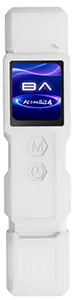
Water Detective 4 is a personal/household portable water quality tester pen, mainly used for rapid screening and comparison of tap water, purified water, bottled water, travel water and aquarium water. It integrates parameters such as TOC, COD, UV254, TDS, EC, turbidity, hardness, salinity and temperature, and measures EC/TDS via a conductivity sensor. However, its measurement list includes neither free chlorine nor pH.
This means: Water Detective 4 cannot determine whether pool hygiene is compliant. It cannot answer the two core questions of "is there enough disinfectant" and "is pH within the effective range." If you wish to use it for trend observation of pool water, you must first confirm sample compatibility and measurement range — the product documentation does not list pool water as a validated sample type. In addition, hardness and salinity estimates are limited by water sample matrix and calibration; they can only be used as reference and cannot serve as a basis for compliance.
| Test Parameter | Supported by Water Detective 4 | Significance for Pool Hygiene |
|---|---|---|
| Free chlorine | Not supported | Core disinfection parameter; must be tested with DPD or an equivalent method |
| pH | Not supported | Affects chlorine activity and bather comfort; must be tested with phenol red or a pH meter |
| Temperature | Supported | Affects chlorine consumption and microbial growth rate; can be used for trend records |
| Turbidity | Supported | Can observe changes in clarity, but cannot replace microbial parameters |
| TDS/EC | Supported | Reflects the trend of total dissolved solids; does not represent disinfection effectiveness |
| Hardness/Salinity | Supported | Limited by matrix and calibration; for reference only |
The Difference Between On-Site Pool Screening and Compliance Testing
Portable water quality testers are on-site screening and trend-monitoring tools, suitable for quickly observing changes, recording anomalies or supporting dosing decisions. They do not have the legal validity of laboratory analysis and should not be used to issue hygiene compliance certificates, opening acceptance conclusions or outbreak investigation conclusions.
Regulatory pool water testing usually requires a qualified laboratory to test microbial parameters (such as E. coli and heterotrophic plate count), free chlorine, pH, turbidity, etc., using standard methods. If a pool has a disease outbreak, persistent turbidity or abnormal disinfectant consumption, samples should be sent to a qualified laboratory rather than relying on portable devices.
For hot tubs or complex water systems, routine Legionella testing is likewise part of an independent public health program and requires laboratory methods such as culture or PCR; portable devices cannot replace them [2].
Practical Testing Sequence for Pool Users/Home Pool Owners
- Before each use or daily: Measure free chlorine with a DPD test kit or photometer, and pH with phenol red or a pH meter. Ensure free chlorine ≥1 mg/L (pool) or ≥3 mg/L (hot tub/spa), and pH between 7.2 and 7.8.
- Weekly: Check total alkalinity and calcium hardness, confirming with test strips or titration as needed, to prevent pH drift and scaling/corrosion.
- When using Water Detective 4 for trend observation: First confirm the water sample is within the compatible range; record trend data such as temperature, turbidity and TDS/EC, and analyze them in relation to dosing, water changes and bather numbers. Never use these values to judge "whether it is hygienic."
- Public or commercial pools: Establish testing records as required by local regulations, calibrate instruments regularly and send samples to a laboratory for verification.
When a laboratory or other tools are needed
- A disease event such as vomiting or diarrhea occurs in the pool, or multiple users experience discomfort;
- Water remains persistently turbid even when free chlorine and pH are normal;
- A hot tub/spa requires Legionella risk assessment or testing;
- Compliance reports, acceptance reports or test results for legal purposes are required;
- On-site test results are abnormal and accurate quantitative confirmation is needed.
In the above situations, standard-compliant laboratory methods should be used rather than a portable water quality tester.
Actionable checklist
- [ ] Measure free chlorine with DPD or an equivalent method; confirm ≥1 mg/L (pool) or ≥3 mg/L (hot tub/spa)
- [ ] Confirm pH between 7.2 and 7.8 with phenol red or a pH meter
- [ ] If using Water Detective 4, first confirm sample compatibility and measurement range; do not use it to judge free chlorine/pH
- [ ] Record trend data: date, time, water temperature, dosing amount, number of bathers, and watch for abnormal changes
- [ ] For public pools, send samples to a laboratory for microbial testing at the frequency required by local regulations
- [ ] For hot tubs and similar systems, assess Legionella risk annually or as needed, using laboratory methods
FAQ
Q: If the water is clear, is there no need to test free chlorine? A: You still need to test. Free chlorine is continuously consumed with use and organic load; clarity only means low turbidity and does not mean there is enough disinfectant.
Q: Can a water quality tester replace free chlorine testing? A: No. Portable water quality testers such as Water Detective 4 do not measure free chlorine or pH and cannot determine whether pool disinfection is up to standard.
Q: Can the TDS/conductivity of Water Detective 4 indicate pool hygiene? A: No. TDS/EC only reflects the trend of total dissolved solids and has no direct correspondence with microbial safety or disinfectant concentration.
Q: Does a home pool need to be tested every day? A: During periods of frequent use, daily testing of free chlorine and pH is recommended; during low-frequency use, test at least weekly and before each use.
Q: If free chlorine and pH are normal, is the water necessarily safe? A: Not necessarily. Turbidity, total alkalinity, cyanuric acid, filtration/circulation and make-up water conditions should also be monitored, and laboratory microbial testing should be performed regularly.
References
[1] CDC. Home Pool and Hot Tub Water Treatment and Testing. https://www.cdc.gov/healthy-swimming/about/home-pool-and-hot-tub-water-treatment-and-testing.html (accessed: 2026-04-27)
[2] CDC. Routine Testing for Legionella. https://www.cdc.gov/control-legionella/php/toolkit/routine-testing-module.html (accessed: 2026-04-27)
Discuss your application
Tell us your target parameters, water matrix, interface and annual volume. Our engineering team will recommend a practical configuration.
Request a Quote