
Start With the Conclusion: Rising TDS Does Not Equal Membrane Failure
When the TDS reading of household RO permeate suddenly rises, many users' first reaction is to replace the RO membrane. However, the reading of a portable TDS pen is usually derived from the conductivity of water measured by a conductivity sensor and then converted; it reflects the total amount of conductive ions such as inorganic salts and some organic matter in the water, and does not target any specific contaminant. A single TDS increase under uncontrolled conditions is not sufficient to prove that the membrane has been damaged or has failed.
A more reliable approach is to first compare under the same sampling conditions and rule out interference from feed water changes, first-draw water after shutdown, storage tanks and post-filters with mineralization. Only when the trend at the "same point, same flushing state, same temperature, same sample standing time" is still deteriorating should you follow the manufacturer's maintenance manual and specific contaminant testing to confirm membrane replacement.
US EPA WaterSense notes on its point-of-use RO systems page that POU RO systems require maintenance and filter/membrane replacement per the manufacturer's recommendations [1]. The CDC page on choosing home water filters also emphasizes following the manufacturer's instructions and not judging safety solely by taste or a single reading [2].
This Checklist: First Rule Out Three Common Interference Factors
1. Changes in Feed Water TDS
The "baseline" of RO permeate TDS depends first on the feed water. The TDS of municipal water or private well water changes with seasons, rainfall, source switching and pipe repairs. If feed water TDS rises significantly, permeate TDS will also rise with it even if the RO salt rejection rate remains stable. It may look like a "doubling," but the membrane may not be faulty at all.
At minimum, record the following together: feed water TDS, permeate TDS, water temperature and sampling time. Only when feed water conditions are similar is it appropriate to compare RO membrane salt rejection.
2. First-Draw Water After Shutdown
After an RO system shuts down, salts on both sides of the membrane slowly diffuse, causing the "first-draw water" stored in the membrane housing to have a noticeably higher TDS. The first glass of water in the morning or after a long period of non-use often shows a false high TDS.
Standard procedure: first drain a certain volume of water (per the manual, usually several hundred milliliters to 1 liter), then take a "mid-stream" sample for testing. Do not judge the membrane using first-draw water after shutdown.
3. Storage Tank and Post-Filter Mineralization
If the RO system has a pressurized storage tank, water stored in the tank for long periods may contact air, develop bacteria or release substances from the tank wall, causing TDS readings to change. Some models also add post-activated carbon or mineralization filters after the RO membrane, which intentionally release trace minerals and can raise TDS. Such increases do not mean the membrane has failed; they reflect the normal function of post-filters or the need to clean/replace the storage tank.
If your RO system offers dual output of "pure water + mineralized water," be clear about whether you are testing the pure water outlet or the mineralized outlet. TDS at the mineralized outlet is naturally higher.
When Is Membrane Replacement Actually Needed
Only when the following conditions are met should you enter the membrane replacement decision process:
- Sampling after draining first-draw water under the same feed water TDS and temperature;
- RO permeate TDS continues to rise significantly, and the salt rejection rate is below the typical value stated by the manufacturer;
- Water production has dropped noticeably and cannot be restored by flushing;
- Odor, color or microbial issues recur, and post-filters and the storage tank have been ruled out;
- Laboratory test results for specific contaminants (such as nitrate, arsenic, lead, etc.) exceed local limits or the manufacturer's guaranteed removal rate.
Note: Salt rejection rate = (feed water TDS − permeate TDS) ÷ feed water TDS × 100%. Household RO membranes usually have a high salt rejection rate, but the manufacturer's manual prevails. It is not recommended to decide on membrane replacement based on TDS readings alone, and especially not to draw conclusions from a single test with an uncalibrated pen.
| Symptom | Check and Rule Out First | Then Consider Membrane Replacement |
|---|---|---|
| Single rise in permeate TDS | Feed water TDS changes, first-draw water after shutdown, mineralized outlet | Salt rejection of mid-stream water continues to decline under the same feed water |
| High TDS in the first glass of water in the morning | Retest after draining first-draw water | Still high after draining and water production has declined |
| High TDS from the storage tank outlet | Clean/replace the storage tank, test mid-stream pure water | Pure water outlet also rises and salt rejection declines |
| Normal TDS but off-taste | Post-activated carbon, tubing, storage tank | Laboratory test for specific contaminants exceeds limits |
How to Use a Portable Water Quality Tester Pen Without Misjudging
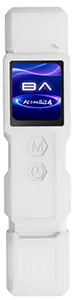
Water Detective 4 is a personal/household portable water quality tester pen integrating nine indicators: TOC, COD, UV254, TDS, EC, turbidity, hardness, salinity and temperature. It is suitable for households, service personnel and on-site screening, but cannot replace laboratory testing required by regulations. When using it to record RO trends, valuable practices include:
- Fix the sampling point, for example always taking mid-stream water at the pure water outlet;
- Record both feed water and permeate readings, not just permeate;
- Record water temperature, because conductivity/TDS readings are affected by temperature;
- Use the same device and the same calibration state for trend comparison; do not compare absolute values across devices;
- Treat readings as screening and trends, not as proof of drinking safety or of specific contaminants.
Special note: parameters such as hardness and salinity are limited by sample matrix and calibration conditions and can only be estimated; indicators such as turbidity and COD are for on-site screening and are not equivalent to laboratory methods. A portable water quality tester pen is good at identifying "what has changed," but "which contaminant is actually over the limit" still requires confirmation by a qualified laboratory.
FAQ
Q: RO permeate TDS rose from 10 to 25 mg/L. Do I need to replace the membrane immediately? Not necessarily. First confirm whether feed water TDS rose at the same time, whether first-draw water was drained, and whether the sample came from the mineralized outlet or the storage tank. Only consider membrane replacement if salt rejection still declines significantly under equivalent conditions.
Q: Can Water Detective 4 prove that RO water is safe to drink directly? No. A portable water quality tester pen is for personal screening and trend comparison and does not replace compliant laboratory testing for specific contaminants such as microorganisms, heavy metals and disinfection by-products.
Q: How often is it reasonable to test? Household users can test a fixed point once a week or every two weeks and record feed/permeate TDS and temperature; if an abnormal trend appears, test more frequently. Service personnel can schedule testing based on filter life and customer maintenance records.
Q: Can the storage tank cause TDS to rise? Possibly. A storage tank that has not been cleaned for a long time may accumulate biofilm or precipitates, causing TDS fluctuations. It is recommended to clean or replace the storage tank at the manufacturer's interval and test mid-stream water after flushing.
Actionable checklist
- First take samples at three points—feed water, RO pure water mid-stream, and storage/post-filter outlet—and record them with numbers;
- Drain first-draw water and take a mid-stream sample for testing;
- Record water temperature, date, and device calibration/sensor status;
- Calculate salt rejection and compare with the manufacturer's manual;
- If salt rejection is stable but permeate TDS changes with feed water, track feed water quality first;
- If post-filter mineralization causes TDS to rise, determine whether it is within the expected range;
- Only after the trend is confirmed should you replace the membrane per the manufacturer's requirements or contact a service provider;
- For compliance or health judgments, send samples to a qualified laboratory to test specific contaminants.
---
References: [1] US EPA WaterSense. Point-of-Use Reverse Osmosis Systems. https://www.epa.gov/watersense/point-use-reverse-osmosis-systems (accessed: 2026-04-27) [2] CDC. About Choosing Home Water Filters. https://www.cdc.gov/drinking-water/prevention/about-choosing-home-water-filters.html (accessed: 2026-04-27)
Discuss your application
Tell us your target parameters, water matrix, interface and annual volume. Our engineering team will recommend a practical configuration.
Request a Quote