
Many households face the same situation: the water purifier starts flashing a replacement reminder, but a water quality tester pen shows TDS and conductivity readings that are fine—sometimes even close to those when the filter was first installed. That is when the thought "I can put it off a bit longer" appears. But the answer is not in a single reading; it lies in two dimensions that readings easily mask: rated lifespan and microbiological control.[1]
Why stable readings cannot prove the filter is still usable
A portable water quality tester measures parameters such as TDS, conductivity and temperature; it is a trend screening tool. It can flag when water quality changes significantly, but it cannot replace the laboratory analysis required by regulations, nor can it directly determine whether a filter has already failed to intercept bacteria, viruses or specific contaminants.[1][2]
What a filter consumes is "interception capacity," not readings
The core capability of an activated carbon filter is adsorbing residual chlorine and some organic matter and improving taste. With use, adsorption sites gradually become saturated. Even if outgoing TDS readings are stable, the activated carbon may already be saturated; continued use will lose the removal effect on residual chlorine and organic matter and may even allow microorganisms to grow.
The lifespan of an ultrafiltration or RO membrane is strongly related to incoming water quality, water usage and backwash frequency. Fouling and biofilm slowly accumulate on the membrane surface, but outgoing TDS may stay low for a long time because the membrane has not yet breached. The real problems are declining permeate output, rising pressure differential and the microbiological risk posed by biofilm.[2]
Rated lifespan is a design value based on conservative conditions
The replacement intervals specified by manufacturers usually account for performance degradation under specific water quality, water usage and temperature conditions. Actual household water usage is often lower than laboratory test conditions; filters may saturate early, or under low usage may allow microorganisms to grow due to prolonged wetness. Therefore, replacing on schedule is the safest approach, rather than relying on readings alone.
Steps for deciding on filter replacement in household settings
Step 1: Check the rated lifespan and time in use
Take out the manual and find the rated treated water volume (usually in liters) or recommended replacement interval for each filter. Also check the purifier's cumulative water usage or installation date. If the rated value has been reached or is close, replace even if readings are normal.
Step 2: Check actual water usage
Many households underestimate their water usage. Record a week's water meter readings and multiply by the number of filter stages to estimate. If actual usage is clearly below the rated value but the time in use has reached one year, also consider microbiological risk, especially for activated carbon filters.
Step 3: Observe changes in flow rate and taste
If the output flow slows noticeably, or the taste becomes odd or off, the filter may already be failing even if readings have not changed. This is a more direct signal than readings.
Step 4: Use a portable tester for trend comparison
After each filter replacement, test the outgoing water once with the same water quality tester and record TDS, conductivity and other readings. Then test every few weeks to observe the trend.
If readings suddenly fluctuate widely, the filter may be damaged or the incoming water quality may have changed; if readings stay stable long-term but the time has come, still replace according to the rated lifespan.
One clarification: a portable tester cannot prove drinking water safety, nor can it detect bacteria or specific contaminants. Its role is to provide a continuous trend record to help you make better-informed decisions when service personnel visit or when you replace filters yourself.
Where Water Detective 4 fits in replacement decisions
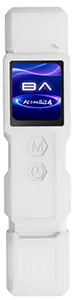
Water Detective 4 is a multi-parameter portable tester pen integrating TOC, COD, UV254, TDS, EC, turbidity, hardness, salinity and temperature. It suits household users, water purification service personnel and on-site screening. Its value in replacement scenarios:
- Fast trend recording: test immediately after each filter replacement to establish baseline data.
- Multi-parameter cross-validation: if TDS is stable but UV254 or turbidity rises, it may indicate breakthrough of organic matter or particulates.
- On-site support for service personnel: helps service personnel quickly assess the difference between incoming and outgoing water, though the final replacement decision should still be based on rated lifespan and flow rate.
To be clear, Water Detective 4 does not measure bacteria, viruses or specific chemical contaminants and cannot serve as a basis for judging the microbiological safety of a filter. Its hardness and salinity readings are estimates and are affected by the water sample matrix. For drinking water safety, rely on local regulations and laboratory testing.[1]
When laboratory testing or other tools are needed
In the following situations, stop relying on portable readings and contact a professional laboratory:
- The household has immunocompromised members who are sensitive to microbiological risk;
- The water source is a private well or mountain spring water, without municipal treatment;
- Outgoing water has an odd odor, color or turbidity that persists after filter replacement;
- Proof is needed that outgoing water meets specific standards (e.g., infant feeding, medical use).
In these cases, water samples should be collected according to standard methods and sent to an accredited laboratory. A portable tester is only an initial screening and cannot replace this.[1]
Frequently asked questions
Q: The portable water quality tester readings have always been good—can I extend the filter's use time?
Not recommended. A filter's rated lifespan is based on manufacturer testing and accounts for microbiological safety and adsorption saturation. Good readings only indicate that some parameters of the current outgoing water have not changed greatly; they cannot prove the filter has not failed. Replacing on schedule is necessary maintenance.
Q: What does a rising TDS reading mean?
Rising TDS may indicate a change in incoming water quality or a decline in RO membrane salt rejection. But different filter structures are affected differently, so judge together with flow rate and taste. If readings suddenly rise by more than 20%, contact a professional for inspection.
Q: Can Water Detective 4 detect bacteria?
No. It measures physical and chemical parameters related to water quality and does not include microbiological indicators. Microbiological safety requires professional laboratory testing.
Actionable checklist
- [ ] Find the manual and record the rated treated water volume and replacement interval for each filter stage
- [ ] Check the purifier's cumulative water usage or installation date
- [ ] Use a portable tester to measure and record outgoing TDS, conductivity and other parameters
- [ ] If the rated lifespan has been reached, replace the filter immediately
- [ ] If flow rate has dropped noticeably or there is an odd odor, replace immediately
- [ ] Archive test records as a basis for later trend comparison
- [ ] If there are immunocompromised members or a special water source, arrange laboratory testing
References
[1] Centers for Disease Control and Prevention. About Choosing Home Water Filters. https://www.cdc.gov/drinking-water/prevention/about-choosing-home-water-filters.html (accessed May 2025)
[2] Centers for Disease Control and Prevention. Preventing Waterborne Germs at Home. https://www.cdc.gov/drinking-water/prevention/preventing-waterborne-germs-at-home.html (accessed May 2025)
Discuss your application
Tell us your target parameters, water matrix, interface and annual volume. Our engineering team will recommend a practical configuration.
Request a Quote