
# Water Quality Tester: Can Cold, Warm and Hot Water Be Compared Directly? Temperature Affects More Than One Number
Direct answer: they cannot be compared directly. When you test the same cup of water with a water quality tester, the TDS/EC readings in cold, warm and hot water are often different. Temperature changes the migration speed of ions in water, which in turn affects conductivity, so temperature itself is a condition that must be recorded, not background noise to be ignored. Only by measuring two samples at similar temperatures, or compensating to 25°C under a uniform rule, can you tell whether "the reading changed" is a difference in water quality or a temperature fluctuation. This article is for household users and water purification service personnel, with actionable steps on how to sample, read and record.
Why Temperature Affects Conductivity and Water Quality Tester Readings
Conductivity measures the ability of water to conduct electric current. As water temperature rises, ions move faster and the conductivity of the same water sample usually increases; conversely, ions migrate more slowly in cold water and conductivity readings are lower[1]. So testing tap water in winter and in summer will give different uncompensated conductivity values even if the water source has not changed.
If a portable water quality tester displays EC/TDS and temperature together, the temperature reading tells you what state the sample is currently in, but it is not an automatically applicable correction factor. Different water bodies and different ion compositions do not respond to temperature in exactly the same way; even if the instrument has internal temperature compensation, it is usually based on a generic or preset coefficient and cannot replace an actual comparison at the same temperature.
Cold, Warm and Hot Water: When You Can Compare and When You Cannot
| Comparison Method | Conditions Required | Conclusion You Can Draw |
|---|---|---|
| Compare at the same temperature in the same container | Let both samples sit in the same environment until their temperatures match, and record the actual temperature | You can compare relative EC/TDS differences and judge the trend of a water purifier or filter cartridge |
| Read directly at different temperatures | Read a single value only, without recording temperature | You cannot tell whether it is a water quality change or a temperature fluctuation; it serves only as a process snapshot |
| Compensate to 25°C | The instrument or the user converts using a uniform temperature coefficient | Suitable for on-site trend screening, but the compensation coefficient is an assumed value and cannot be treated as a laboratory result for the real sample |
On-site sampling emphasizes recording under the same conditions rather than just recording a number[2]. If you really can only measure at different temperatures, at least write down the sample temperature and the reading together, so you will not misjudge when reviewing later.
Correct Sampling Steps for a Portable Water Quality Tester
The following steps are suitable for quick screening in households or water purification services and do not replace laboratory testing.
- Prepare clean containers and a separate thermometer. Use two cups of the same material and place them on heat-insulating mats so the tabletop temperature does not affect the samples.
- Let the samples come close to room temperature. Let hot water sit for a while first; do not insert the probe directly into boiling water, water heater outlet water or steam. For the specific water temperature range that can be contacted, refer to the instructions of the water quality tester you have.
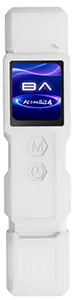
- Check the product instructions. According to the product information on this site, Water Detective 4 is a personal/household portable water quality tester pen for quick testing of tap water, purified water, bottled water, travel water and aquarium water, integrating nine indicators — TOC, COD, UV254, TDS, EC, turbidity, hardness, salinity and temperature — on one platform. It is suitable for quick comparison and recording, but the contact temperature range, reading stabilization time and maintenance method must be taken from the instructions.
- Record complete information. For each reading, write down the date, time, sample source, water temperature, TDS/EC reading and remarks. Try to complete the same set of comparisons within a 2°C temperature difference; this is on-site operating experience, not a product specification.
- Repeat the readings. Measure each sample 2–3 times and take the stable value. If the reading keeps jumping, first check whether the probe is clean, whether the sample still has bubbles, or whether the temperature is still changing.
When Laboratory Tools Are Needed
A portable water quality tester is for personal screening, trend observation and quick comparison in water purification services; it is not for proving that drinking water is safe or that specific contaminants are within limits. If persistent anomalies appear, if accurate values of hardness or salinity need to be determined, or if regulatory requirements are involved, send samples to a qualified laboratory. Hardness and salinity estimates are also limited by sample matrix and calibration, so portable readings must not be treated as laboratory results.
FAQ
Is the temperature shown by a water quality tester the water temperature or the room temperature?
It is usually the water temperature near the sensor, used for recording and helping judge the sample state. Temperature response speed differs between products; it is advisable to wait until the reading stabilizes before recording, rather than using the jumping value right after insertion.
Can hot water be measured directly with a portable water quality tester?
Measuring high-temperature water directly is not recommended. First check the contact temperature range in the instructions, use a heat-insulating mat and a separate thermometer to confirm the water temperature is within the allowed range, and then measure briefly. Never insert the probe directly into boiling water or water heater outlet water.
When testing before and after a water purifier on the same day, within how many degrees of temperature difference can results be compared?
There is no uniform standard, but in on-site screening try to let the raw water and the treated water drop to similar temperatures in the same environment before measuring. After recording the actual temperatures, if the difference is small, the trend judgment is more informative; if the difference is large, resample or note "different temperatures, for recording only".
Actionable checklist
- [ ] Prepare two cups of the same material, a separate thermometer and a heat-insulating mat
- [ ] Let the sample temperature come close to room temperature and avoid direct contact of hot water with the tester pen
- [ ] Check the contact temperature range and operating requirements in the water quality tester instructions
- [ ] Record date, time, sample name, water temperature and TDS/EC reading
- [ ] Repeat 2–3 times under the same conditions and take the stable reading
- [ ] Send anomalous samples to a laboratory; do not draw safety conclusions from portable results
References
[1] U.S. Geological Survey (USGS) Water Science School. Conductivity (Electrical Conductance) and Water. https://www.usgs.gov/water-science-school/science/conductivity-electrical-conductance-and-water (accessed: 2026-04-27)
[2] U.S. Geological Survey (USGS). National Field Manual for the Collection of Water-Quality Data. https://www.usgs.gov/mission-areas/water-resources/science/national-field-manual-collection-water-quality-data-nfm (accessed: 2026-04-27)
Discuss your application
Tell us your target parameters, water matrix, interface and annual volume. Our engineering team will recommend a practical configuration.
Request a Quote